Read more about our corporate brand here.

Search
Fixed Income Strategy

Options for excess cash: Balancing liquidity, risk and yield

Christi Fletcher, Darrell Leong
August 27, 2026

Key takeaways

  • Rising rates have put cash management into the spotlight, and many investors are taking a closer look at income potential versus risk.
  • When it comes to corporate treasury cash management, it's vital to know the nuances between government money market funds, short-duration bond funds and separately managed accounts (SMAs).
  • Organizations that practice cash segmentation—clearly dividing excess cash into operating, reserve and strategic tiers—may achieve greater income potential while maintaining appropriate liquidity.

As banks have reduced certain types of lending due to regulatory and capital constraints, private credit managers have stepped in to fill the gap. We continue our exploration of private credit in this month's Credit vista, Private credit and banks: An evolving relationship.

Economic vista: The right path for excess cash

Christi Fletcher, Senior Portfolio Manager

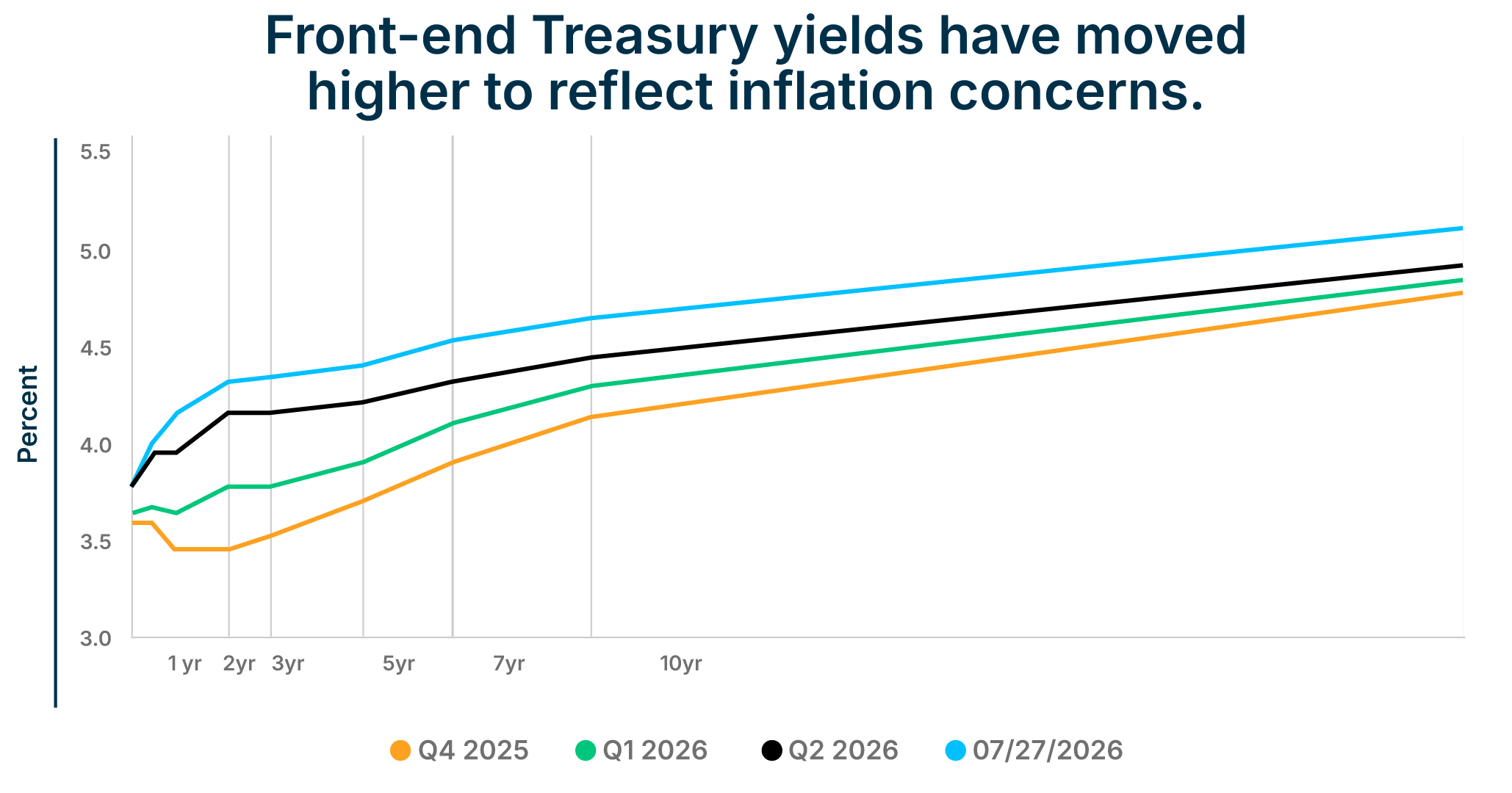
Some investors may be fretting about inflation data and a Federal Reserve that is signaling a more restrictive monetary policy stance. Certainly, that's how the US Treasury curve has interpreted the situation. However, the flip side is that the current environment now offers investors the potential to capture more attractive yields in a variety of ways. As interest rates remain elevated relative to the past decade, treasury teams are reevaluating how they manage excess cash. Which path is right for you? Let's take a closer look at some of today's viable options.

Understanding the nuances

While preserving principal and maintaining liquidity remain paramount, many organizations are asking whether they can generate additional income without taking undue risk. Thus, understanding the differences between government money market funds, short-duration bond funds and SMAs can help organizations align their cash investment strategy with their liquidity needs and risk tolerance.

In our experience, companies in the innovation economy are taking a closer look at what to do with excess cash in a business environment—specifically, how to generate income without compromising the liquidity their operations require. The key challenge for many of these organizations is balancing uncertain operating timelines with the desire to earn additional income on strategic cash reserves.

The primary distinction among these investment options is the trade-off between liquidity, principal stability and income potential. Finding that sweet spot is key. As investors move from government money market funds toward SMAs and short-duration bond funds, the opportunity for additional income generally increases along with interest rate risk, credit risk and liquidity risk. A useful way to understand this trade-off is through net asset value (NAV), which represents the market value of a fund's holdings on a per-share basis.

Government money market funds are structured to maintain a stable NAV, typically $1 per share. As a result, investors generally expect a dollar invested to remain a dollar in value while earning income through the fund's yield. This stability is one of the primary reasons money market funds are commonly used for operating cash and near-term liquidity needs.

By contrast, short-duration bond funds have a floating NAV that changes as interest rates move and market conditions evolve. While these funds may offer higher income potential, investors should expect periodic fluctuations in value, meaning there may be times when the fund's market value is temporarily below the original investment amount.

Similarly, SMAs can also experience changes in market value because the underlying securities are marked-to-market (i.e., valued based on what the price of the security is today as opposed to the price you originally paid for it). However, unlike a fund structure in which an organization may invest, investors using SMAs own the individual securities directly and can therefore use customized portfolio guidelines, liquidity requirements and risk parameters to align with their specific objectives. That's a key advantage.

The cost of income potential

For investors, understanding NAV is important because it helps illustrate the trade-off between principal stability and income potential. Generally, the greater the opportunity to earn additional income, the more likely an investor is to experience some degree of price fluctuation along the way. In other words, if you can stomach a bit of volatility, you are likely to be able to capture greater yields.

While the range of available options can seem complex, the following table highlights the key characteristics of each strategy.
Common characteristics

Government money market fund

SMA

Short-duration bond fund

Primary objective

Preserve principal and provide daily liquidity

Preserve capital while enhancing yield over cash

Generate income and total return

Typical investment horizon

Overnight to 6 months

6 to 18 months

1 to 3+ years

Duration of portfolio/fund

0.05 to 0.20 years

0.25 to 1 year

1 to 3 years

Average maturities

30 to 60 days

3 to 12 months

1 to 5 years

Interest rate sensitivity

Very low

Low

Moderate

Credit quality

US government/agency focused

High quality investment grade (AAA to A-), customizable

Investment grade to high yield

Credit spread risk

Minimal

Low

Moderate

Liquidity risk

Minimal

Low

Low to moderate

NAV stability

Stable NAV structure

Floating market value

Floating market value

Expected price volatility

Near zero

Low

Moderate

Potential for monthly negative return

Very Low

Possible

Common during rate shocks

Corporate bond exposure

None

Often included, but customizable

Common

Asset-backed securities exposure

None

Often included, but customizable

Common

Treasury exposure

High

Typically 40 to 50%

Variable

Customization

None

High

None unless separately managed

Transparency

Limited fund-level reporting

Direct security ownership

Fund-level reporting

Suitability for operating cash

Excellent

Good

Low

Behavior during credit stress

Resilient

Some spread widening impact

Greater spread widening impact

Likelihood of outperforming cash over full cycle

None

Depends on risk tolerance

High

Government money market funds are designed to provide maximum safety and liquidity. They invest in short-term US Treasuries and other US agencies (for example: Federal Home Loan Bank, Fannie Mae, Freddie Mac and Farm Credit), along with US Treasury/US-agency backed repurchase agreements. Because these securities mature quickly and have minimal credit risk, government money market funds are considered one of the most conservative investment options available for managing operational cash.

Simply put, the primary goal for these government money market funds is preserving principal while providing daily liquidity. These funds are often described as "a dollar in, a dollar out" investments. Returns are lower than those with longer-term bond investments, but these government money market funds offer stability during periods of economic uncertainty or market volatility.

A little further out on the risk curve are short-duration bond funds, which invest in bonds with relatively short maturities, in general between one and five years. These funds may hold a combination of US Treasuries, US agencies and investment-grade corporate bonds (typically rated AAA through BBB-), mortgage-backed securities and asset-backed securities. Transparency is limited to what the fund provides as far as holdings and exposures. Compared to government money market funds, short-duration bond funds generally offer higher income potential. In exchange, investors assume a greater interest rate and credit risk, which can sometimes result in fluctuations in the fund's NAV. This means the value of the investment may temporarily decline during periods of market volatility.

SMAs offer the highest degree of flexibility among the three options. Because investors own the underlying securities directly, portfolios can be customized to align with specific liquidity requirements, risk tolerances and income objectives. SMAs provide investors with visibility into how the portfolio is performing, and insight into liquidity needs. Moreover, portfolio guidelines can be tailored to factors such as permissible asset types, maturity limits, minimum credit quality, issuer concentration limits and sector exposure. For organizations with defined liquidity forecasts, this customization can help balance capital preservation, income generation and liquidity management within a single investment strategy.

Which is the best option for excess cash?

For organizations weighing where to put excess cash, the answer depends on the intended purpose and time horizon of each cash tranche. So how do you determine which option best fits your needs?

In general, government money market funds are great options for immediate cash needs, such as near-term payroll or one- to six-month operating cash needs. The primary goals are capital preservation, immediate liquidity and safety. They function as a cash management tool and are appropriate when funds may be needed in the near term.

SMAs are often most appropriate for reserve cash that is not needed immediately but still requires a defined liquidity profile. By tailoring maturity limits, credit parameters and sector exposure with an SMA, organizations can seek incremental income while maintaining investment guidelines that align with their operational requirements. Cash expected to remain invested for six to 12 months may be invested differently than funds needed for near-term operations, potentially helping organizations earn additional income while maintaining appropriate liquidity.

Short-duration bond funds may be better suited if it's more important to capture potentially higher income while accepting a moderate level of interest rate and credit risk. This option can provide an effective balance between stability and return but with a longer investment horizon, usually 18+ months. In all likelihood, this would be better known as strategic cash or cash for longer-term deployment, as opposed to an immediate need such as covering payroll.

Cash segment type

Purpose

Typical horizon

Potential solution

Operating cash

Payroll, near-term spending

0 to 6 months

Government money market fund

Reserve cash

Monthly liquidity and short-term reserves

6 to 18 months

SMA

Strategic cash

Longer-term income allocation

18+ months

Short-duration bond fund/SMA

Let objectives dictate approach

Ultimately, we believe that the most important question is not which vehicle is best, but rather which vehicle is best suited to a particular cash objective. Organizations that clearly segment operating cash, reserve cash and strategic cash can often improve income potential while maintaining appropriate levels of liquidity and principal preservation. By aligning investment structures with liquidity needs, treasury teams can potentially enhance income while maintaining a risk profile that remains consistent with their operational and financial objectives.

Credit vista: Private credit and banks: An evolving relationship

Darrell Leong, CFA, Managing Director, Head of Investment Research

When it's smooth sailing and investors are raking in juicy yields, nobody pays much heed. But when occasional turbulence hits, investors begin asking questions. That's been the case with private credit this year. With that in mind, we continue with another article to provide more insight into this corner of the lending world. Specifically, we endeavor to answer some common questions about the growing connection between private credit and US banks and how much risk they are taking.

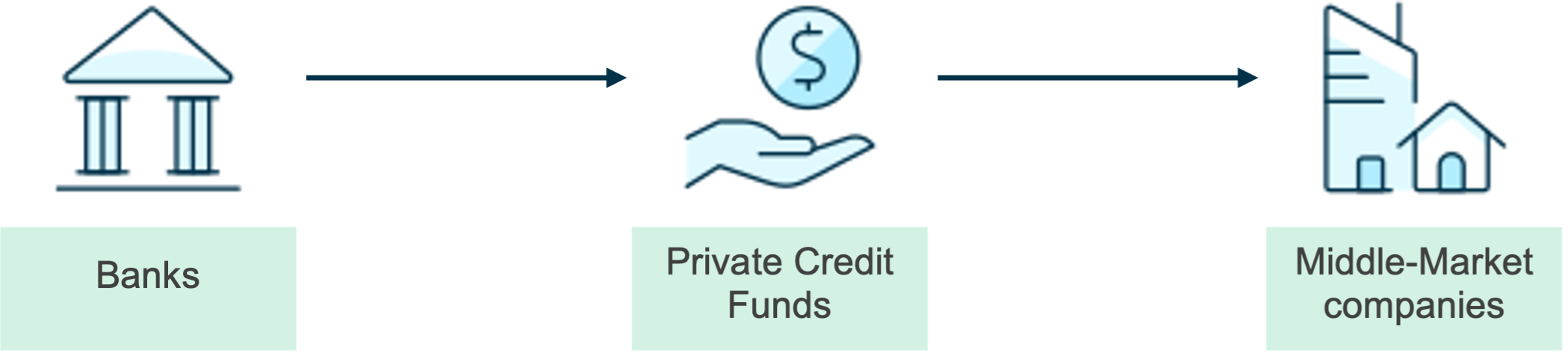
A common misconception is that banks are the primary lenders in private credit loans made to middle-market firms. In reality, private credit is a nonbank lending activity performed by financial institutions, such as asset managers, pension funds, insurance companies and business development companies (BDCs). After the Global Financial Crisis in 2009, banks' appetite for leveraged lending to small and mid-sized firms decreased due to regulatory reforms and balance sheet constraints, pushing many borrowers to nonbank lenders for financing.

Direct lending is one of the more prominent investment strategies within private credit. These funds typically lend to middle-market firms, many owned by private equity sponsors. Investors mainly access direct lending loans through BDCs and private debt funds. (Read last month's article for a detailed look at private credit and direct lending.)

Banks to private credit funds flow diagram

Banks' role in private credit

Although banks are not the principal players in the private credit ecosystem, they are playing an evolving role by providing liquidity. They accomplish this in four primary ways:

  1. Back leverage facilities. Banks provide secured loans to private credit funds through a Special Purpose Vehicle (SPV) secured by middle-market loan portfolios. These facilities increase fund leverage and amplify yields, while including structural risk protection for banks, such as collateral approval, borrowing base and re-margining rights.
  2. Subscription lines of credit or capital call lines. Banks provide revolving facilities to private credit funds, secured by limited partners' unfunded capital commitments. The subscription credit lines allow fund managers to deploy capital quickly before receiving funds from their investors.
  3. NAV facilities. Banks provide secured debt at the fund level through an SPV to a private credit fund based on the net value of the loan portfolio or equity value of the fund. NAV loans support portfolio growth of private credit funds.
  4. BDC credit lines. Banks lend funds to the BDC, allowing the BDC to increase its investment capacity and internal returns. The loan is backed by the loan portfolio of the BDC.

These arrangements illustrate an important distinction that banks generally lend to private credit investment vehicles rather than directly holding the underlying middle market loans.

Growing participation in private credit

Beyond credit lines, banks are exploring new ways to participate in the growth of direct lending to middle-market firms through partnership and joint ventures, instead of holding loans on their balance sheet.

We see three main areas where deeper partnerships have emerged:

  1. Deal sourcing. Banks serve as deal sourcing partners for business development companies or private credit funds. Banks can help customers gain access to another source of funding without keeping the loan on their balance sheet. In return, banks earn structuring and referral fees without bearing credit risk.
  2. Joint ventures. Banks create joint ventures with private credit investment firms to participate in direct lending. These joint ventures are created off-balance sheet with the bank's financial commitment as an equity investor or debt provider to the new entity.
  3. Co-investment. Some large banks co-invest along with private credit funds in loans to middle market firms. Recent announcements highlight growing strategic interest in this rapidly growing market. Last year, J.P. Morgan announced a $50B private credit commitment to invest in direct loans to middle-market companies.D In February 2026, Bank of America (BofA) announced a $25B commitment to invest in direct lending private credit deals.D If fully deployed, each commitment would represent about 1% of the bank's total assets.

Direct exposure appears limited, but indirect exposure is growing

We believe that banks have little direct exposure to the underlying middle market loans associated with private credit. Instead, banks primarily act as a counterparty to private credit managers by providing loans at the fund level. Within direct lending strategies, the underlying loan assets remain on the balance sheets of BDCs and private credit funds, not banks.

Limited direct exposure does not mean no risk for banks. Banks remain indirectly exposed through fund-level lending, investment and co-investments with risk varying by structure, borrower quality, collateral and leverage. These distinctions matter.

Private credit can be an attractive financing option for middle market companies when supported by disciplined underwriting and due diligence. Performance has varied across the asset class, reinforcing our view that neither private credit nor bank involvement in the market should be evaluated from a single risk lens. For investors, how a bank participates matters more than whether it participates.


Markets

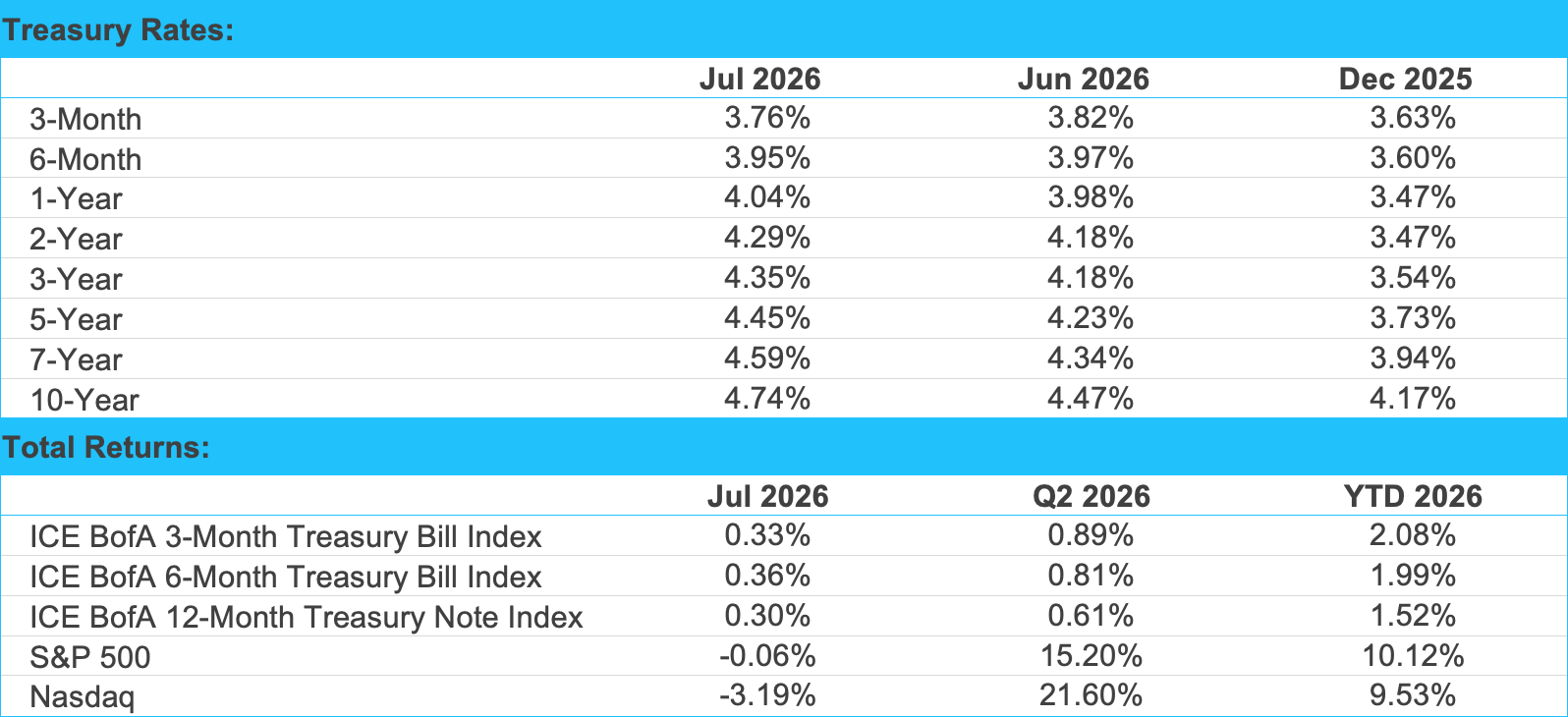
Financial data table summarizing treasury rates and total returns Source: Bloomberg and SVB Asset Management as of 07/31/2026.
Financial comparison table with interest rates for different terms Source: Bloomberg, Tradeweb and SVB Asset Management as of 07/27/2026.
Line chart illustrates changes in front-end U.S. Treasury yields over time Source: Bloomberg, Tradeweb and SVB Asset Management as of 07/27/2026.
Economic indicators summary table for April 2026 Source: Bloomberg and SVB as of 08/12/2026. US Bureau of Economic Analysis and US Bureau of Labor Statistics. *Current GDP release as of 07/30/2026. †Quarter over quarter. **Consumer Price Index. ***Personal consumption expenditures. ‡Current PCE release as of 07/30/2026.

Read next

Explore these related articles to help you stay on top of the latest data, insights and developments in the venture-backed crypto and blockchain ecosystem.

Front-end bond yields and short-duration fixed income Fixed Income Strategy
Read Article Article

Front-end bond yields and short-duration fixed income

Sep 29, 2026

Steve Johnson, Timothy Lee

The Expansion of Space Tech: To Infinity and Beyond Aerospace and Defense
Read Article Article

The Expansion of Space Tech: To Infinity and Beyond

Sep 22, 2026

Kyle McQuighan, Ryan Larson

Capitalize on low option costs for FX hedging FX Risk Advisory for Corporates
Read Article Article

Capitalize on low option costs for FX hedging

Sep 16, 2026

Irwin Bautista, Grayson Prickett

More about the authors

Christi Fletcher

Christi Fletcher

Senior Portfolio Manager

Darrell Leong

Darrell Leong

Managing Director, Head of Investment Research


This information is provided for educational purposes only and should not be relied on or interpreted as accounting, financial planning, investment, legal or tax advice. First Citizens Bank (or its affiliates) neither endorses nor guarantees this information, and encourages you to consult a professional for advice applicable to your specific situation. Third parties mentioned are not affiliated with First-Citizens Bank & Trust Company.

None of this material, nor its content, nor any copy of it, may be altered in any way, copied, transmitted or distributed to any other party, without the prior express written permission of SVB Asset Management. SVB Asset Management is an investment adviser registered with the U.S. Securities and Exchange Commission (SEC). Registration with the SEC does not in any way constitute an endorsement by the SEC of an investment adviser’s skill or expertise. Moreover, registration does not imply that a registered adviser has achieved a certain level of skill, competency, sophistication, expertise or training in providing advisory services to its clients. SVB Asset Management is a wholly owned, non-bank subsidiary of First-Citizens Bank & Trust Company. For institutional purposes only.

Investment products and services offered by SVB Asset Management:

Are Not insured by the FDIC or any other federal government agency Are Not deposits of or guaranteed by a Bank May Lose Value

© 2026 First-Citizens Bank & Trust Company. All rights reserved. First Citizens Bank is a registered trademark of First Citizens BancShares, Inc.

Back to top
You are now leaving First Citizens Innovation Banking

You will be directed to a different website or mobile app that has its own terms of use, visitor agreement, security and privacy policies. First Citizens Innovation Banking is not responsible for (and does not provide) any products, services or content at the third party site or app, except for the products and services that carry the First Citizens Innovation Banking name.