


Jump To
Reports
Innovation in Women's Health
2026
Megan Scheffel, Adam Tweedy, Nina Kandilian, Alex Lennox-Miller, Josh Pherigo, Urbashee Paul
Key takeaways
Drawing from SVB's proprietary data and insights and interviews with prominent investors and founders, our 2026 Innovation in Women's Health report examines trends across the venture-backed women's health sector, which has expanded well beyond reproductive and sexual health to address the full spectrum of women's health needs. Now a proving ground for the future of medicine, the sector is pioneering advances in integrated care, personalization and technology that are setting new standards of care for all patients.
$2B
VC invested in women's health across the US and Europe in 2025.
While this marked a dip from the 2024 peak, projections show a rebound in both deal volume and total women's health funding for 2026.
$6.2B
VC invested since 2019 in companies addressing conditions unique to women.
Plus 210 new startups dedicated to solving women-specific health challenges have launched in the same timeframe.
35M
Median pre-money valuation for AI-enabled women's health companies.
Startups using AI to personalize care are commanding valuations triple those of their non-AI counterparts.
The data
Our data unpacks the numbers behind the women's health opportunity, from the $2B invested in 2025 to the soaring valuations for AI-driven companies. We pinpoint where funding aligns with need and where the largest gaps remain across all women's health needs.
Sector outlook
A 2025 dip gives way to a stronger 2026
US women's health VC saw a $1.2B pullback in 2025, but early indications suggest a rebound in 2026 as a new wave of seed and Series A companies prepares to emerge.
The dip reflects the sector's focus on therapeutics and care delivery, making it less susceptible to the AI investment hype in 2024 that inflated other healthcare verticals—and setting the stage for more stable, long-term growth.
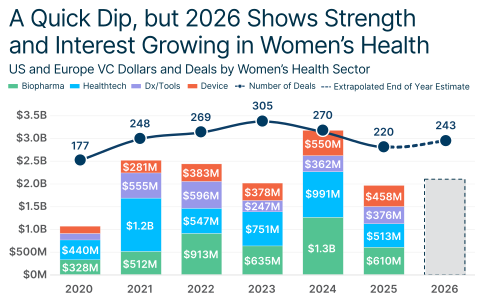 Notes: All deals either include institutional venture investment, corporate venture investment or are equal to or greater than $2M, regardless of investor. Dates of financing rounds are subject to change based on add-on investments. The projection for 2026 is based on identified women's health companies which raised a deal as of 5/15/2026 along with new deals for additional companies identified through Pitchbook industry tagging. Source: PitchBook Data, Inc. and SVB proprietary data and analysis.
Pre-money valuations
Investors triple down on women's health AI
Valuations for AI-powered women's health companies were nearly 3x the sector median, a sharp departure from prior years when little difference existed between them.
Women's health AI investment is concentrated in clinical tools that predict and prevent costly health events like hospitalization and serious illness, rather than the drug discovery and operations focus in broader healthcare AI.
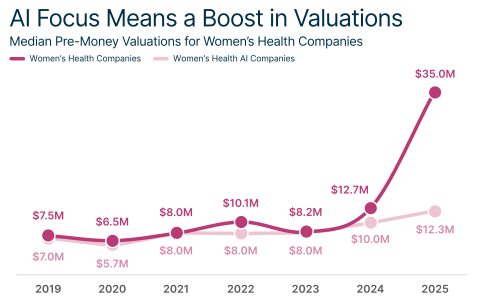 Source: PitchBook Data, Inc. and SVB proprietary data.
Fund flows
Investment aligns with shared disease burden
Diseases with high patient populations and low investment tend to attract VC funding. As a result, major women's health concerns tend to attract more money if they impact men as well.
This focus means women's health companies are helping to prove the value of personalized and precision medicine in a broader set of conditions that affect a variety of patients.
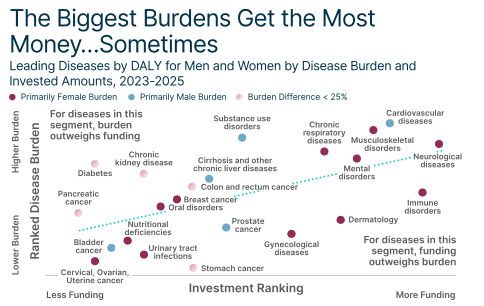 Source: Institute for Health Metrics and Evaluation, DealForma, PitchBook Data, Inc. and SVB proprietary data.
More about the authors






Explore other reports
 Reports
 Report
The Future of Climate Tech
Apr 15, 2026
Jordan Kanis, Eli Oftedal, Josh Pherigo, Andrew Pardo
 Reports
Report
Reports
Report
50 BY 2050
Jordan Kanis, Joshua Posamentier, Eliza Cushman, Marianne Wu, Hilla Watkins
 Reports
Report
Reports
Report
The State of Corporate Venture Capital 2026
Mark Gallagher, Patrick Eggen, Mikey Kalis, Emma Eschweiler, Abbie Wolf, Anjalika Komatireddy, Eli Oftedal, Jake Ledbetter