


Jump To
Reports
The Future of Climate Tech
Jordan Kanis, Eli Oftedal, Josh Pherigo, Andrew Pardo
April 15, 2026
Key takeaways
The Future of Climate Tech is Silicon Valley Bank’s annual climate tech report examining venture capital investment, startup funding and innovation trends across the climate tech industry. Backed by SVB proprietary data and our unique vantage point in the innovation economy, the report explores a pivotal moment for the sector: while climate tech companies navigate a constrained funding environment by focusing on profitability, the long-term demand for their solutions has become undeniable. Our analysis shows how rising climate costs, better unit economics and the massive energy needs of AI and electrification make climate tech essential to future economic growth.
$29B
Total US VC investment in climate tech in 2025.
This marks the third-highest year on record, behind 2021 and 2022 — led by investments in clean energy amid slower deal activity in most climate tech subsectors.
50+
Federal actions since 2024 have raised headwinds for climate tech.
Pullbacks in funding, research, permitting and staffing are delaying projects and causing heightened uncertainty.
52%
Of climate tech companies have reduced net burn YoY as gross margins improved.
Founders remain focused on improving unit economics and building profitable, efficient businesses.
Explore the Future of Climate Tech report
Get insights on the emerging trends shaping innovation around climate tech
The data
This year’s report examines the latest trends shaping climate tech innovation, exploring the disconnect between a skeptical market and the physical-world demand driven by electrification, improving unit economics and climate disruptions.
MARKET SNAPSHOT
Investment is up; deals are down
US climate tech VC investment reached $29B in 2025 — the third-highest year ever behind 2021 and 2022..
This near-record funding doesn’t reflect the reality for most climate tech companies. Capital was concentrated in a handful of large, late-stage deals 10 of which captured 28% of all investment.
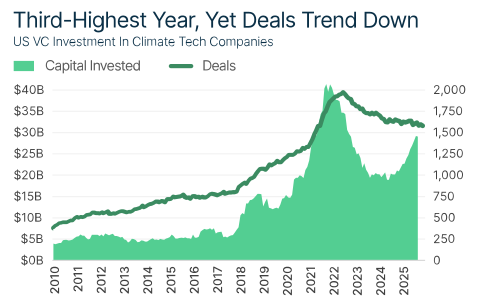 Source: PitchBook Data, Inc. and SVB analysis.
FEDERAL SUPPORT
Policy is creating new friction for founders
Since 2025, federal support has eroded through decreased funding, weaker research capacity, adverse permitting policy and fewer tax incentives.
For founders and investors, this policy shift has constrained access to programs, slowed project deployment and injected significant uncertainty into the climate tech market.
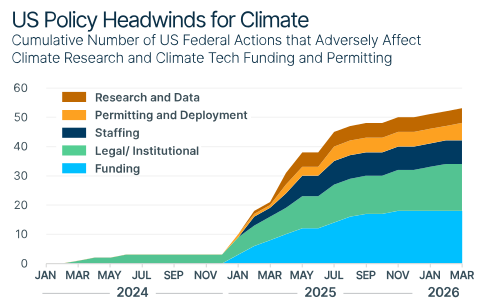 Source: US Supreme Court, White House, Reuters, US EPA, NOAA, Utility Dive, American Institute of Physics, Bureau of Ocean Energy Management, US Department of Energy, US Department of the Treasury and SVB analysis.
FINANCIAL DISCIPLINE
The pivot to profitability pays off
Climate tech companies are boosting gross margins by focusing on core unit economics by shedding weaker production lines and designing for manufacturing efficiency.
This new operational discipline is working: a record 52% of VC-backed climate tech companies reduced their net burn YoY, prioritizing resilience over growth-at-all-costs.
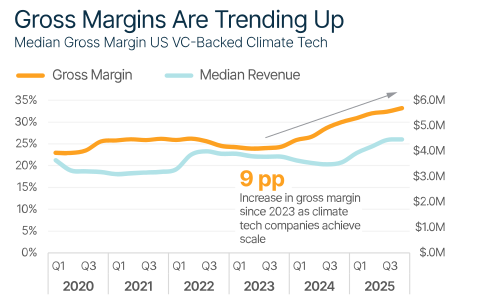 Source: SVB proprietary data and SVB analysis.
More about the authors




Explore other reports
 Reports
 Report
The Future of Climate Tech
Apr 15, 2026
Jordan Kanis, Eli Oftedal, Josh Pherigo, Andrew Pardo
 Reports
Report
Reports
Report
50 BY 2050
Jordan Kanis, Joshua Posamentier, Eliza Cushman, Marianne Wu, Hilla Watkins
 Reports
Report
Reports
Report
The State of Corporate Venture Capital 2026
Mark Gallagher, Patrick Eggen, Mikey Kalis, Emma Eschweiler, Abbie Wolf, Anjalika Komatireddy, Eli Oftedal, Jake Ledbetter