
Read more about our corporate brand here.

Search
FX Risk Advisory for Corporates

Capitalize on low option costs for FX hedging

FX options are often dismissed as expensive. Current market conditions may warrant a second look.
Irwin Bautista, Grayson Prickett
September 16, 2026

Key takeaways

  • Options allow global businesses to protect budgets, add flexibility, and allow for beneficial moves if forecasts shift.
  • For companies holding USD, interest earned on operating cash can help fund option premiums and improve hedge economics.
  • A lower FX volatility market coupled with a high-interest rate regime may be creating an opportunistic window for options hedging.

For institutions managing foreign currency cash flows, the current market may offer a rare opportunity to add rate protection and flexibility at reduced costs.

Though the recent markets have seemed uncertain, options prices, surprisingly, have not reflected this risk. Inflation, interest rates, growth expectations, and geopolitical risk continue to pull the dollar in different directions. At the same time, implied volatility has moved lower, bringing down the cost of option protection. To add even another point to the equation, interest rates are near recent highs, offering an attractive rate for dollar holders.

That combination is worth paying attention to. Options can help global institutions protect against adverse currency moves while keeping room to benefit if the market moves in their favor. And for companies holding USD before future foreign currency payments, today's cash yields can help offset a meaningful portion of the premium. Right now, that premium may be easier to justify.

Why option costs look more interesting today

Currency implied volatility, one of the main drivers of FX option pricing, has fallen to its lowest level of 2026. That has helped pull option costs lower.

Part of the reason is that the market has lacked a clear direction. There are still good arguments on both sides of the dollar. Inflation and higher-for-longer interest rates could continue to support the dollar. Geopolitical risk could also keep demand for the dollar firm, especially if investors want safe-haven assets.

At the same time, markets can change quickly. If geopolitical tensions ease or investors become more comfortable taking risk, some of the dollar's recent support could fade. Strong US growth and labor-market resilience are also already well understood by the market, which may limit how much further those themes can carry the dollar on their own.

That leaves companies in an unusual spot. 
Option costs are lower, but the range of possible currency outcomes still feels wide. For companies that want protection without giving up flexibility, this may be a good time to revisit options.

A practical example

Consider a US company with €20 million of European operating expenses spread across 12 monthly payments. A stronger foreign currency versus the USD will increase the cost to fund operations.

One choice would be to convert the full amount upfront. That takes the FX risk off the table, but it also means deploying all the dollars right away and forfeiting USD interest earned. Forwards may be used to achieve certainty for the monthly flows, whilst delaying the conversion.

A third approach is to buy a strip of EUR/USD options, with one option matched to each monthly payment date. The company pays the option premium upfront, and similar to the forwards keeps the dollars invested until each euro payment is due.

That cash balance matters.

As illustrated in Exhibit 1, the option strip costs about $316,000. The dollars waiting to be used for the euro payments earn about $434,000 of interest over the same period. The hedge starts to pay for itself around the four-month point, and across the full strip, the interest earned is more than the option premium.

When USD yields are still meaningful and option costs are lower, the math can look better than many global institutions might expect.

Tenor

Premium (% notional)

Option Premium

USD Yield

Interest Earned

Funded %

1M

0.59%

$9,827

3.73%

$5,182

53%

2M

0.86%

$14,338

3.78%

$10,492

73%

3M

1.06%

$17,736

3.82%

$15,929

90%

4M

1.25%

$20,751

3.87%

$21,481

104%

5M

1.40%

$23,379

3.91%

$27,155

116%

6M

1.54%

$25,741

3.95%

$32,950

128%

7M

1.71%

$28,444

3.98%

$38,699

136%

8M

1.85%

$30,912

4.01%

$44,522

144%

9M

1.99%

$33,196

4.03%

$50,419

152%

10M

2.12%

$35,333

4.06%

$56,389

160%

11M

2.24%

$37,349

4.09%

$62,433

167%

12M

2.36%

$39,260

4.11%

$68,550

175%

Strip

1.58%

316,297

$434,201

137%

Justifying the premium expense

The premium is usually the hardest part of the options conversation. But the premium buys real value, especially when exposures are not perfectly predictable.

  • Budget protection - Options allow hedgers to set a worst-case FX rate. That can help protect margins, budgets, and forecast cash flows from an adverse currency move.
  • Room to benefit if rates move favorably - With a forward, an institution locks in the rate. With a purchased option, the company has protection but can still benefit if the market moves in its favor.
  • More flexibility around timing and amount - Options better accommodate uncertainty in forecasting, planning, and analysis (FP&A) cash flow forecasts, including changes to expected timing and notional amounts.
  • Lower use of credit capacity - Because a premium is paid to own the option, purchased options do not have to be supported by a credit facility. For institutions managing limited credit capacity, that can be an important consideration.
  • More flexibility if plans change - A purchased option may also be sold or unwound before expiration, depending on market conditions and the structure. That can be helpful if the underlying exposure changes.

Why this matters now

The current setup is unusual. Option premiums are lower, USD cash yields remain meaningful, and the FX outlook is still uncertain.

For global companies and venture/private equity funds with foreign-denominated cash flows , that combination may create a more attractive entry point for options.

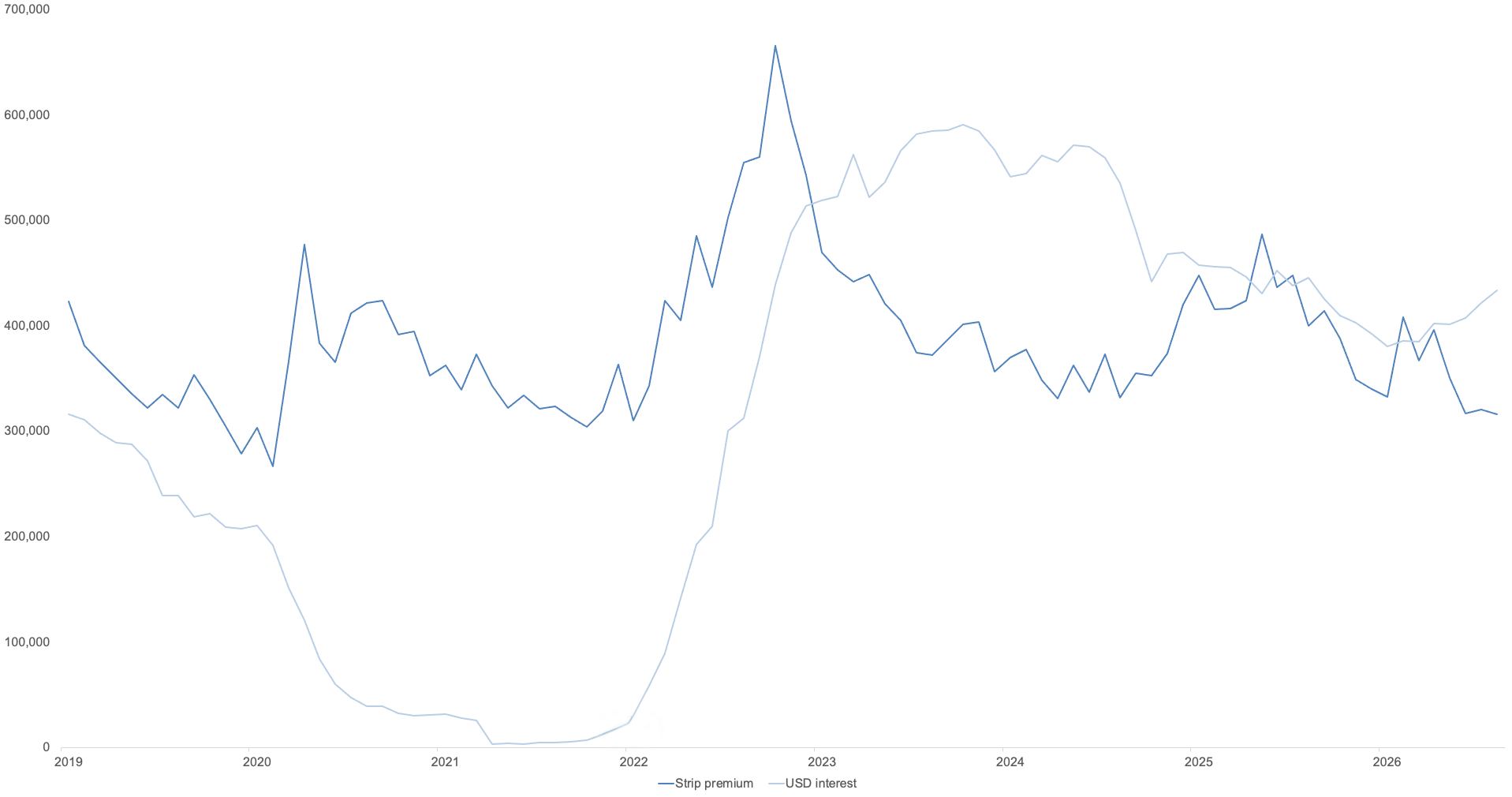
This recent dynamic in which yields exceed premiums started when the Federal Reserve raised interest rates in 2022/2023 to fight inflation (Exhibit 2).  That said, this setup is the exception, not the rule.  Market participants who lived through the zero-rate environment after the 2008 Global Financial Crisis could never have imagined deposit rates paying for option premiums in full.  But periods like this do not always last.  If volatility rises, policy expectations shift, or the market finds a clearer direction, the cost of adding flexibility could move higher quickly.

Exhibit 2: Historical analysis of strip premium versus interest income on €20 million

Line chart comparing price premium and interest Source: Bloomberg 8/31/26.

If you would like to review your specific situation to determine if options are right for you, please reach out to your primary FX contact or send a note to fxriskadvisory@firstcitizens.com.

Read next

Explore these related articles to help you stay on top of the latest data, insights and developments in the venture-backed crypto and blockchain ecosystem.

Front-end bond yields and short-duration fixed income Fixed Income Strategy
Read Article Article

Front-end bond yields and short-duration fixed income

Sep 29, 2026

Steve Johnson, Timothy Lee

The Expansion of Space Tech: To Infinity and Beyond Aerospace and Defense
Read Article Article

The Expansion of Space Tech: To Infinity and Beyond

Sep 22, 2026

Kyle McQuighan, Ryan Larson

Capitalize on low option costs for FX hedging FX Risk Advisory for Corporates
Read Article Article

Capitalize on low option costs for FX hedging

Sep 16, 2026

Irwin Bautista, Grayson Prickett

More about the authors

Irwin Bautista

Irwin Bautista

Sr. FX Advisor

Grayson Prickett

Grayson Prickett

Vice President


This material is for informational purposes only and is not intended to be an offer, specific investment strategy, recommendation or solicitation to purchase or sell any security or insurance product and should not be construed as legal, tax or accounting advice. Please consult with your legal or tax advisor regarding the particular facts and circumstances of your situation prior to making any financial decision. While we believe that the information presented is from reliable sources, we do not represent, warrant or guarantee that it is accurate or complete.

This material is for informational purposes only and is not intended to be an offer, specific investment strategy, recommendation, or solicitation to purchase or sell any security or insurance product, and should not be construed as legal, tax, or accounting advice. Please consult with your legal or tax advisor regarding the particular facts and circumstances of your situation prior to making any financial decision. While we believe that the information presented is from reliable sources, we do not represent, warrant, or guarantee that it is accurate or complete.

Foreign exchange transactions can be highly risky, and losses may occur in short periods of time if there is an adverse movement of exchange rates. Exchange rates can be highly volatile and are impacted by numerous economic, political and social factors as well as supply and demand and governmental intervention, control and adjustments. Investments in financial instruments carry significant risk, including the possible loss of the principal amount invested. Before entering any foreign exchange transaction, you should obtain advice from your own accounting, tax, financial, legal and other advisors and only make investment decisions on the basis of your own objectives, experience and resources.

Back to top
You are now leaving First Citizens Innovation Banking

You will be directed to a different website or mobile app that has its own terms of use, visitor agreement, security and privacy policies. First Citizens Innovation Banking is not responsible for (and does not provide) any products, services or content at the third party site or app, except for the products and services that carry the First Citizens Innovation Banking name.