What are the differences between startup accelerators vs. incubators?
The terms are sometimes used interchangeably, but there are well-agreed upon differences between accelerators and incubators.
Accelerators aim to do literally that: accelerate your startup's growth. Applicants will be expected to have something more than an idea, be it a prototype or product. As was mentioned earlier, accelerators provide intensive guidance, support and structure for a set period of time, most commonly three months. They'll expose you to advice from a wide range of mentors. You’ll be building toward a demo day event when you'll present your idea to potential investors and other interested parties, including press.
Incubators, on the other hand, provide a more flexible, long-term, and nurturing environment, sometimes lasting years, for startups still refining their ideas, building initial teams, and seeking product-market fit, usually without requiring equity or offering direct funding.
As an early-stage startup founder, an accelerator will likely immerse you in a high-pressure, fast-paced environment with structured milestones and frequent mentor sessions aimed at achieving quick traction and preparing you for fundraising. You can expect to refine your business model under intense scrutiny, gain exposure to a wide network of investors, and work towards a demo day presentation. Conversely, in an incubator, you'll experience a more relaxed pace, with ample time and resources to experiment with your product, develop your business model and organically build your team. Furthermore, you can benefit from a shared workspace and ongoing, ad hoc mentorship without an equity stake or the immediate pressure to scale rapidly.
What do accelerators offer startups?
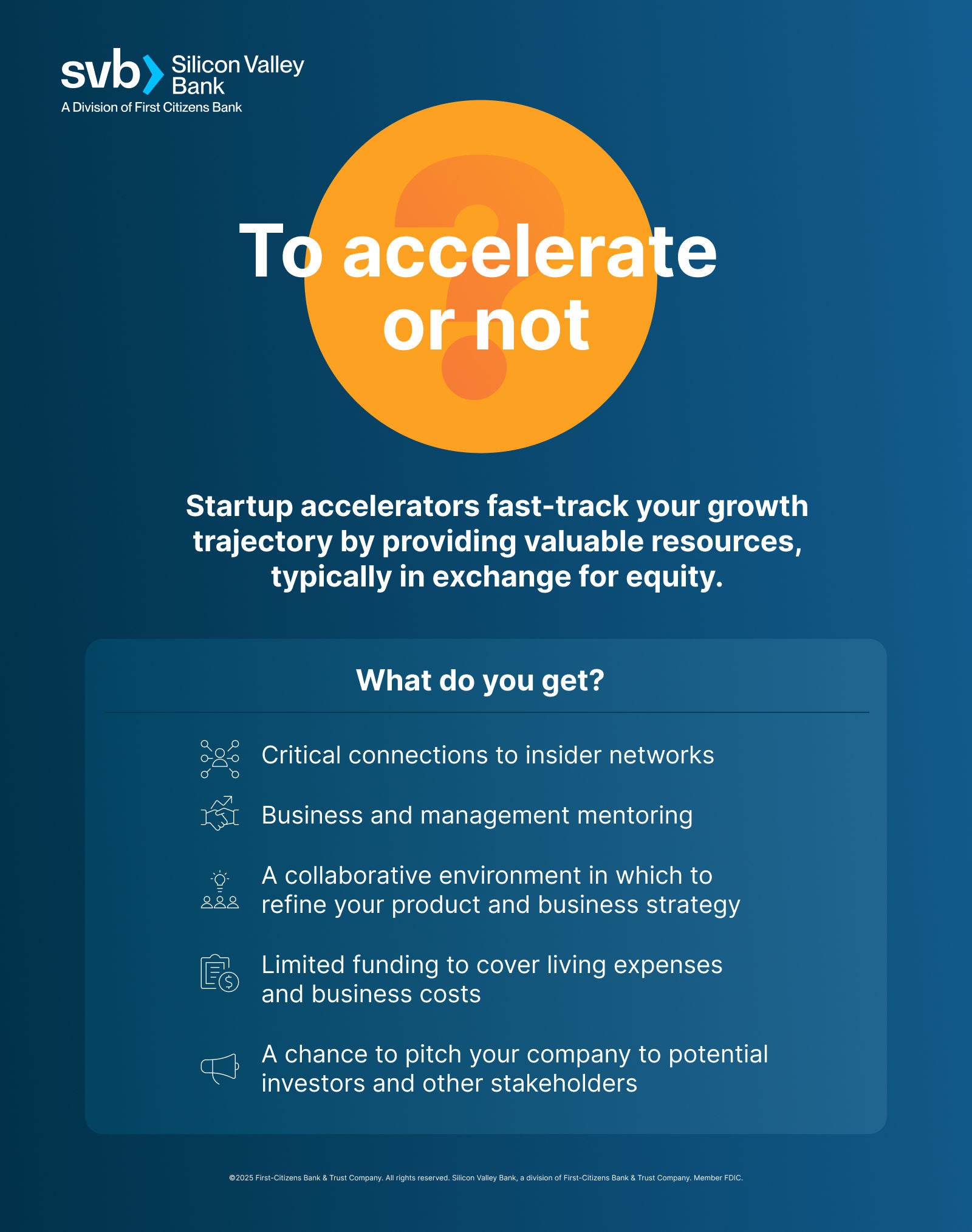
There are four major ways an accelerator can help you take a company from idea to execution:
1. Critical connections
Well-known accelerators work closely with angel investors and venture capital firms that are looking to invest in promising business ideas. Additionally, an accelerator can introduce you to an ecosystem network dedicated to helping you progress your idea into a company. If you are new to the industry, this is particularly useful. By connecting you to a network of advisors, you can become part of a culture within a short amount of time. Being a member of this insider network can give you credibility that will help with both hiring and fundraising.
2. Business and management mentoring
Accelerators are instrumental in matching inexperienced founders with the right management guidance to transform innovative ideas into viable businesses. For participants, being part of a cohort of founders going through similar challenges can be an amazing experience. Such programs teach you to navigate personnel, fundraising and scaling issues. It's comparable to a college experience where the requirements are minimal, and it is up to you to make the most of it. Becoming part of a prestigious accelerator program can educate you in numerous ways, optimize you for fundraising and truly enhance early company cohesion.
Following the program's conclusion, companies often successfully raise significant seed rounds from notable investors on favorable terms. Within a year, your startup can experience substantial growth, more than tripling both your revenue and headcount. This transformative period underscores a clear distinction in your journey, marking a pivotal "before and after" due to the accelerator's impact.
3. Collaborative environment
Whether virtual or in person, startup accelerators provide informal feedback and guidance on the technology or business concept you're pursuing. These "hackerspaces" or "makerspaces" are collaborative workspaces where engineers and creative problem-solvers can help you pivot from an exhausted idea or break down a good idea and rebuild it into something even better. Many startup accelerators focus on specific types of businesses and amass high levels of expertise within their accelerator.
4. Access to physical space and camaraderie
Many entrepreneurs take advantage of open coworking spaces, offices, conference rooms, workbenches and other facilities. Not only is it nice to have the space, but you can also benefit from the emotional support that comes from being alongside other team members from different projects. Everyone is facing similar challenges, and you can help one another by bouncing ideas around and engaging with CEOs and alumni.
Choosing the right accelerator for your startup
The key is getting into a quality accelerator. Talk to other founders who have gone through an accelerator to figure out which one is a fit for you. Other accelerators or incubators may make sense for your founding team if they specialize in your startup's sector. Leading US universities also have well-regarded accelerators, including MIT's delta v. Corporations sponsor well-respected accelerators like Johnson & Johnson’s JLABS, as mentioned above. And there are some strong regional accelerators, such as MucketLab in Los Angeles and the Entrepreneurs Roundtable in New York.
Applying to a well-respected startup accelerator can be difficult, but the real work begins once you're accepted. Whether you're participating virtually or traveling to attend in person, be ready to set up with your team and get started.
Here's what you can expect from typical startup accelerators:
- Fast-paced days
- Educational seminars and workshops on topics like fundraising, HR, working with legal counsel, pitching practice and product development
- Group and one-on-one mentorship from industry experts, investors and successful founders
- Regular check-ins with accelerator leadership such as investors and alumni founders
You should think carefully and weigh the advantages of a startup accelerator against the cost, particularly in time and equity.
A startup accelerator can be a big distraction. You know that creating a company in any sector is an around-the-clock endeavor. Committing to an accelerator can rob you of time that could be spent building product, hiring key staff and closing sales.
Additionally, timing is everything. You may be too early for an accelerator. Alternatively, you may be too late if you have already raised venture money. And perhaps your founding team already has the depth of knowledge and experience that would make an accelerator superfluous. Consider whether your company is at the right stage to benefit.




 Article