


Economic vista: Beyond the big numbers
Jose Sevilla, Senior Portfolio Manager
The numbers are so large that it's hard to get your head around them. On top of that, many investors are not clear on the differences between deficit and debt. Nevertheless, we think investors should endeavor to understand a bit more about the nation's mounting national debt, as well as its potential impact on US and global markets.
The national debt represents the total amount of money the federal government has borrowed to cover expenses over time. When annual spending (e.g., on healthcare, defense, and infrastructure) exceeds revenue (from taxes), a budget deficit occurs. To finance this deficit, the government issues US Treasury bonds. The national debt is the sum of these borrowings plus interest owed.
Annual deficits, a common occurrence, is the main cause for the mounting national debt. "On Oct 20, the US government posted a $1.695 trillion budget deficit in fiscal 2023, a 23% jump from the prior year as revenues fell and spending on Social Security, Medicare and record-high interest costs on the federal debt have risen. The Treasury Department said the deficit was the largest since a COVID-fueled $2.78 trillion gap in 2021."D The US faces a daunting fiscal challenge as its national debt continues to soar. Given the size and scope, this debt has far-reaching implications for both the US economy and markets. Let's consider some of the causes, consequences, and potential impact on the markets.
As of the fourth quarter 2023, the national debt had surpassed $33 trillion, equating to 122% of US GDP. Several factors contributed to this growing debt. High spending on entitlement programs like Social Security and Medicare, defense, and debt interest payments have resulted in consistent budget deficits, even during economic growth. The challenges are exacerbated during times of economic downturns, which tend to result in lower tax receipts and higher spending on safety net programs (programs like unemployment benefits, food assistance, and healthcare). This naturally increases annual deficits and was clearly illustrated by the economic turmoil caused by the COVID-19 pandemic. But remember, if the federal government continually carries such high debt levels, it can potentially restrict policymakers' ability to respond to future crises. If another recession occurs, stimulus options may be limited due to the mounting national debt. Finally, tax reforms, such as the Tax Cuts and Jobs Act of 2017, have reduced government revenue, also exacerbating the deficit.
Market Implications
Through an investment lens, it's hard to ignore the implications. As national debt grows, so do the interest payments required to service this debt. In 2023, the US government spent $658 billion on net interest costs, a 38% increase from 2022, representing 2.4% of GDP. Interest payments to holders of US government debt is the fourth-largest government expense, behind Social Security, Medicare, and defense, and is currently the fastest growing part of the federal budget. Increases in these payments divert capital resources from critical areas like infrastructure, education, and healthcare, and can hinder long-term economic growth and societal well-being. This "crowding out" effect also discourages private investment due to the higher borrowing costs.
The soaring national debt significantly impacts financial markets, particularly the fixed income sector. US Treasury securities are considered the safe-haven asset (with yields on Treasuries sometimes referenced as the "risk-free rate") and a cornerstone of the bond markets. Their yields directly impact other fixed income instruments. To fund its spending, the US government issues more bonds. This increased supply can lead to higher yields to attract buyers and as investors demand compensation for the added risk.
US Treasuries have long been considered a rock-solid, lower-risk investment. A default or loss of confidence in US debt seems unthinkable and could disrupt global financial stability. Interestingly, foreign investors are the biggest holders of US government debt. Any doubts about repayment would put pressure on the high-quality credit ratings that Treasuries currently enjoy. This could trigger a capital flight, raise volatility and cause a ripple effect throughout global markets. After all, investor confidence in US debt influences demand for US Treasury securities. And persistent concerns about debt sustainability could result in a vicious cycle whereby higher interest rates further increase the cost of servicing the debt.
By no means are we doomsayers or sounding alarm bells. However, we want to highlight that America's mounting national debt matters and could pose significant challenges for both the US economy and global financial markets. The mounting debt (and interest payments) ultimately could divert resources from crucial public spending, crowding out private investment, and limiting any fiscal response during crises. Moreover, the global impact is profound, as the safe-haven status of US Treasuries and the stability of the dollar are vital to global financial stability. We continue to have the utmost confidence in the safe-haven status of US Treasuries; however, we simply are reiterating that the US government has a fiscal responsibility to manage the national debt and ensure the long-term economic stability and growth of the economy.
Credit vista: Good grades for IG
Darrell Leong, CFA, Managing Director, Head of Investment Research
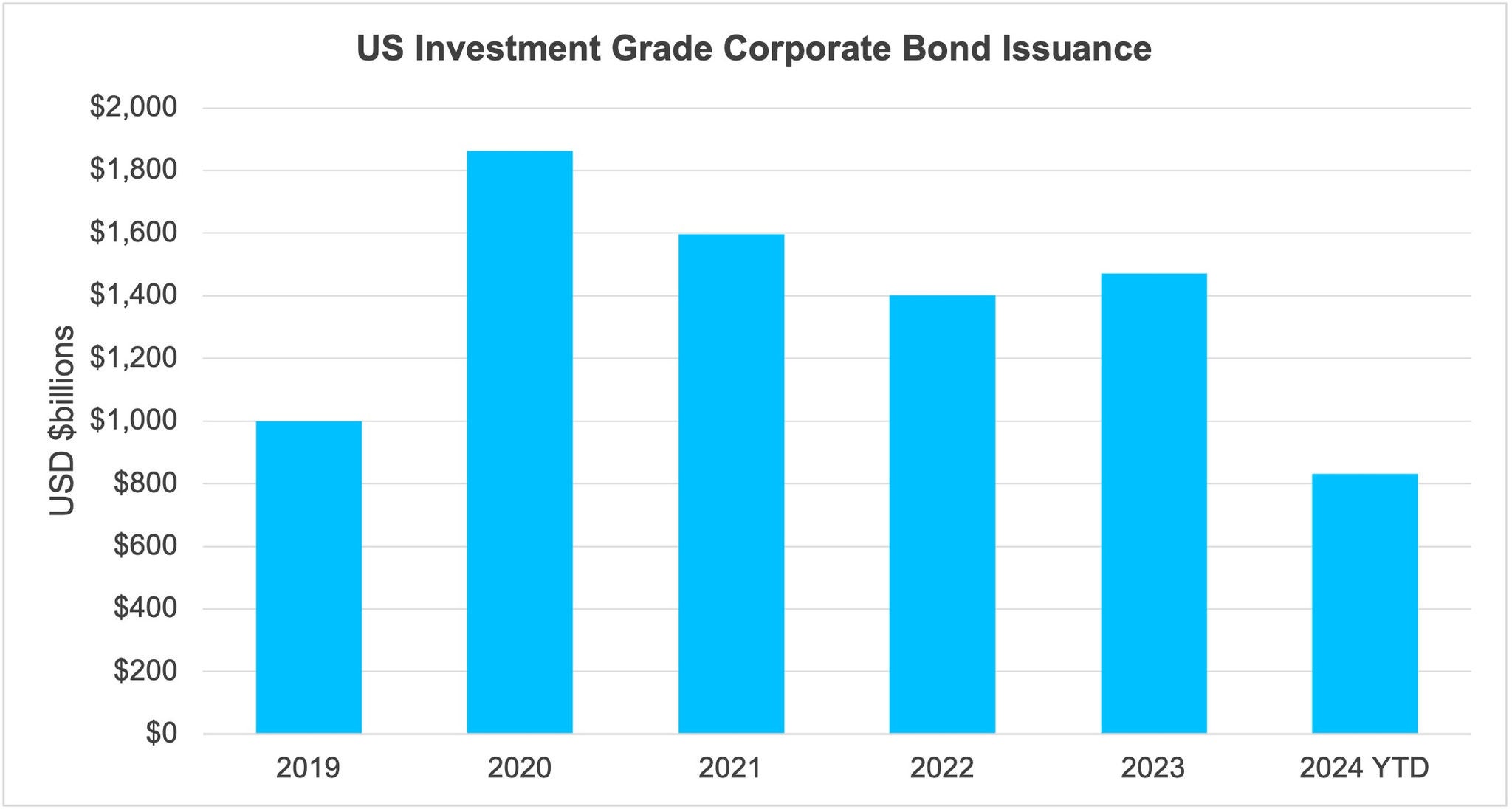
It was a fast start, but will it last? The new issue investment grade (IG) corporate bond market got off to blazing start in the beginning of 2024. January and February had robust market activity with a pace of issuance that was on track to exceed $2 trillion for 2024. That would qualify as an annual record. While primary issuance has moderated over the past few months, it continues growing at a healthy clip.
Corporate America has been very successful issuing new bonds this year, and why not? Earnings have been relatively strong on the whole, and there has been no recession despite interest rates that have remained "higher for longer," as the Federal Reserve had been warning. While financials represent approximately 40% of IG bond issuance, non-financial sector issuance has been gaining momentum as well, thanks in part to significant M&A activity in the healthcare sector. During the first two months of the year, buoyed by US pharmaceutical M&A activity, the healthcare sector has seen impressive issuance from the likes of AbbVie for $15 billion and Bristol Myers Squibb for $13 billion. Expectations are rising for additional deals in 2024, which could push overall new issuance forecasts even higher.

 Article