The profile of borrowers has evolved since Unchained launched, expanding beyond early tech adopters to a broader range of professional classes, including doctors, lawyers and dentists. To meet changing client needs, Unchained has introduced financial services such as tax advising, estate planning and Bitcoin-backed IRAs.
As of June 2026, the company's website disclosed that loans start at $150,000 and carry a 14%-16% APR, with borrowers using funds for purposes ranging from real estate to business investments. Clients take out money to buy property or make an investment. A cabinet maker bought new tools and retrofitted his garage. Another client bought an airplane. All clients value the security of their Bitcoin. Unchained has also seen increased onboarding following the failures of earlier crypto lenders such as BlockFi and Celsius, reflecting continued demand for Bitcoin-backed liquidity solutions.
Why Bitcoin loans cost more (for now)
One thing Ledn, Unchained and their peers share is cost. Bitcoin-backed loans currently carry higher interest rates higher than what a borrower would typically pay against a home or a stock portfolio. The credit spread premium reflects several realities. Bitcoin's price volatility demands continuous monitoring that traditional lenders don't need. Additionally, the market has not yet attracted enough competing capital to compress margins.
Capital allocators are already interested. As more institutional capital enters the lending market—drawn by securitizations like Ledn's ABS—competition should drive rates down toward something closer to securities-backed lending. Zaria's expanded agency services could accelerate that process by opening the door to a broader universe of traditional lenders that are not yet participating. Tied together, these threads point toward cheaper Bitcoin lending on the horizon.
Lightning: Lending and payments are two sides of the same (Bit)coin
The same institutional maturity in lending has a parallel with Lightning Network payments. This Layer-2 protocol sits just above the Bitcoin settlement layer. Broadly, Lightning transactions share the same premise as stablecoins: to enable faster and lower-cost settlement in certain use cases. But while stablecoins peg their value to the dollar and operate on a patchwork of networks, Lightning is fixed to Bitcoin. That makes it well-suited for the growing number of Bitcoin-backed companies.
As awareness of the benefits of blockchain-based treasury is growing, companies are becoming more interested in using the Lightning Network. The main constraint is implementation. Converting to Bitcoin-based products takes a shift in company culture.
"Stablecoins embody the speed of settlement and transparency that crypto proponents have always valued, and the other side is now interested in it," said Graham Krizek, Founder and CEO of Voltage. "The convo has shifted from 'should we do it?' to 'how do we do it?'"
How the Lightning Network works
Rather than record every transaction on the blockchain, which can be slow and costly, Lightning participants open payment channels by locking Bitcoin on-chain, then transact freely off-chain, only settling the final balance to the blockchain when the channel closes.
In traditional finance terms, Lightning is like the interbank lending system, which extends nearly free short-term credit to banks throughout the day to maintain liquidity. Lightning also provides low-cost payment liquidity, but it does so globally 24/7 with counterparty risk that differs from traditional rails because the funds are already secured. Unlike intraday credit, which is generally available to US banks and regulated institutions, Lightning is available to anyone with a node and an internet connection.
Lightning is positioned to add volume. The network has about 5,000 BTC of channel capacity, which means about $350 million worth of BTC is locked into the network and ready to route payments at any given moment. This amount resets itself nearly instantly when a payment clears, allowing the same pool of BTC to settle millions of transactions.
Setting up and maintaining a node is how companies like Voltage thrive. Founded in 2020, Voltage provides enterprise infrastructure for companies using the Lightning Network for transactions.
The biggest users of Lightning today are high-frequency, cross-border applications like iGaming.
To service these businesses, Voltage offers a revolving credit line called "Voltage Credit." Gaming is a primary use case because it involves many small transactions between the same counterparties repeatedly, often across borders where traditional payment rails are slow, expensive or unavailable. International remittances and creator economy micropayments fit the same profile. But the largest category of untapped potential is stablecoins.
Stablecoins already deliver fast and cheap payments, but they do so across a fragmented patchwork of competing networks that each carry their own fees, settlement structures and security assumptions. Moving among these chains is a notorious security vulnerability that has been responsible for some of the largest hacks in crypto history. Stablecoins on Lightning would collapse that fragmentation into a single network, which would be a win for the ecosystem overall, according to Krizek.
"Stablecoins on Lightning can move faster and cheaper than other chains. There is also that trust and predictability of Bitcoin. Bitcoin is the rail and the tracks for it to run on," Krizek explained.
For now, this is still a long-term goal. Lightning's most immediate impact may not wait for stablecoins at all. The very structure that makes Bitcoin loans so reliable for lenders is prime for running on Lightning. Margin calls, collateral posting and liquidations could execute instantly on the network. Borrowers approaching an LTV threshold could post more collateral instantly with the Lightning Network.
On the borrower side, the technical capability is there. Providers such as CashApp, Coinbase and Kraken all support Lightning. The integration of this technology on the lending side is the next phase.
"It's a chicken and egg problem," said Krizek. "We've come a long way from the borrower side. Now, we need the lenders to support it."
The road ahead for Bitcoin: Lower rates and broader adoption
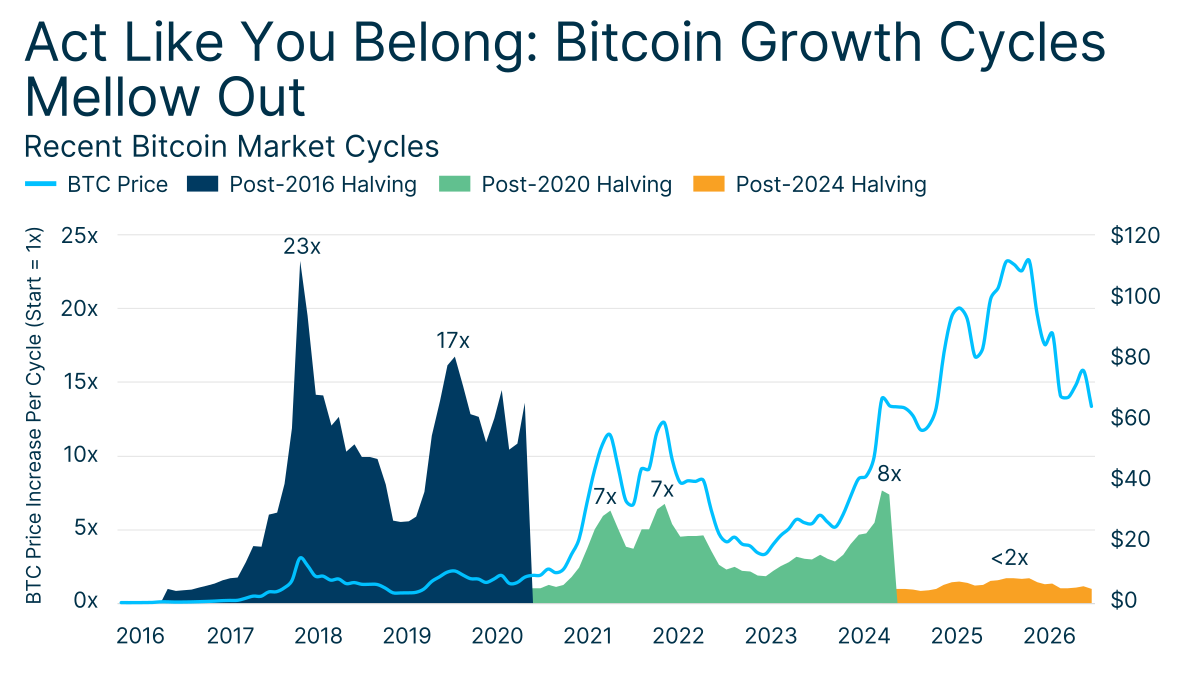
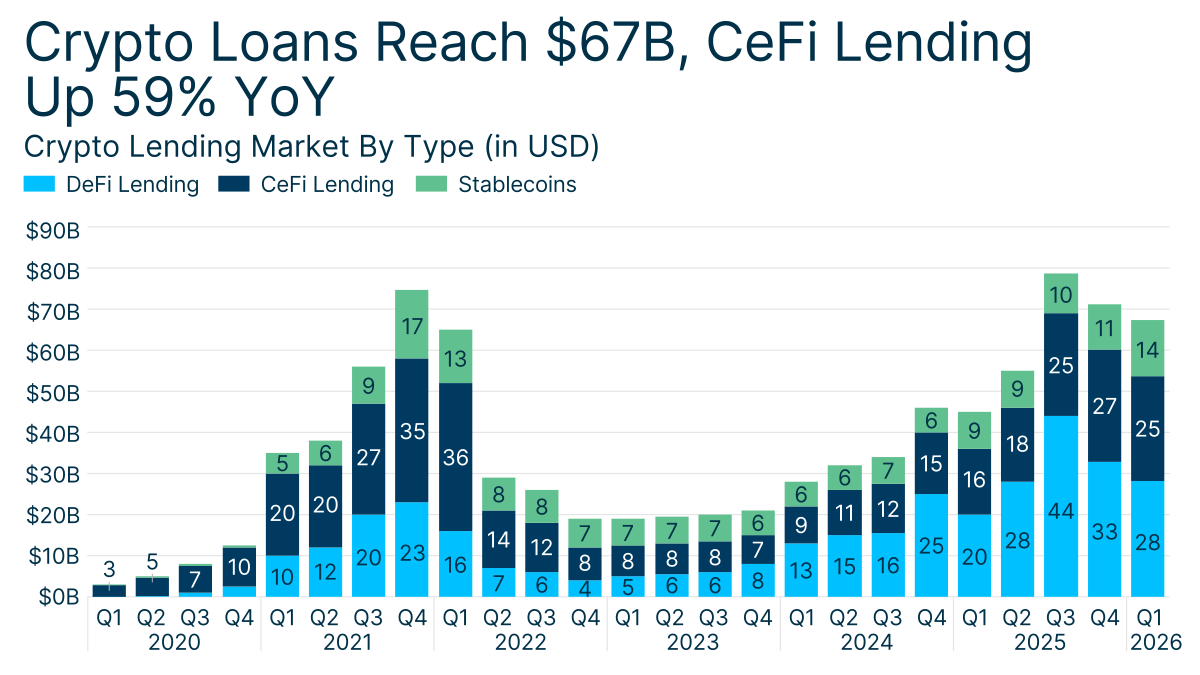
Bitcoin has spent much of its existence seeking to prove it belongs. Some now view it as collateral with instant and global liquidity, fast settlement, fungibility and minimal risk. Bitcoin's next challenge is to scale as a full-service asset class within established credit and payment frameworks. A limiting factor is not only borrower demand, but also consistent access to capital.
As the space becomes more understood, we expect more pockets of private credit, as well as more banks, to provide capital in the near term. Already, we're seeing signs that costs are coming down. In May, Strike's unveiling of a 7.5% rate for term loans of more than $5 million is a significant step-down in pricing and a glimpse of where pricing could be headed. Tether extended a $2.1 billion credit facility to expand Strike's lending efforts. Looking ahead we expect a broader mix of funding sources could lower rates and risks.






 Article