


Bitcoin's journey from fringe curiosity to mainstream store of value is undeniable.
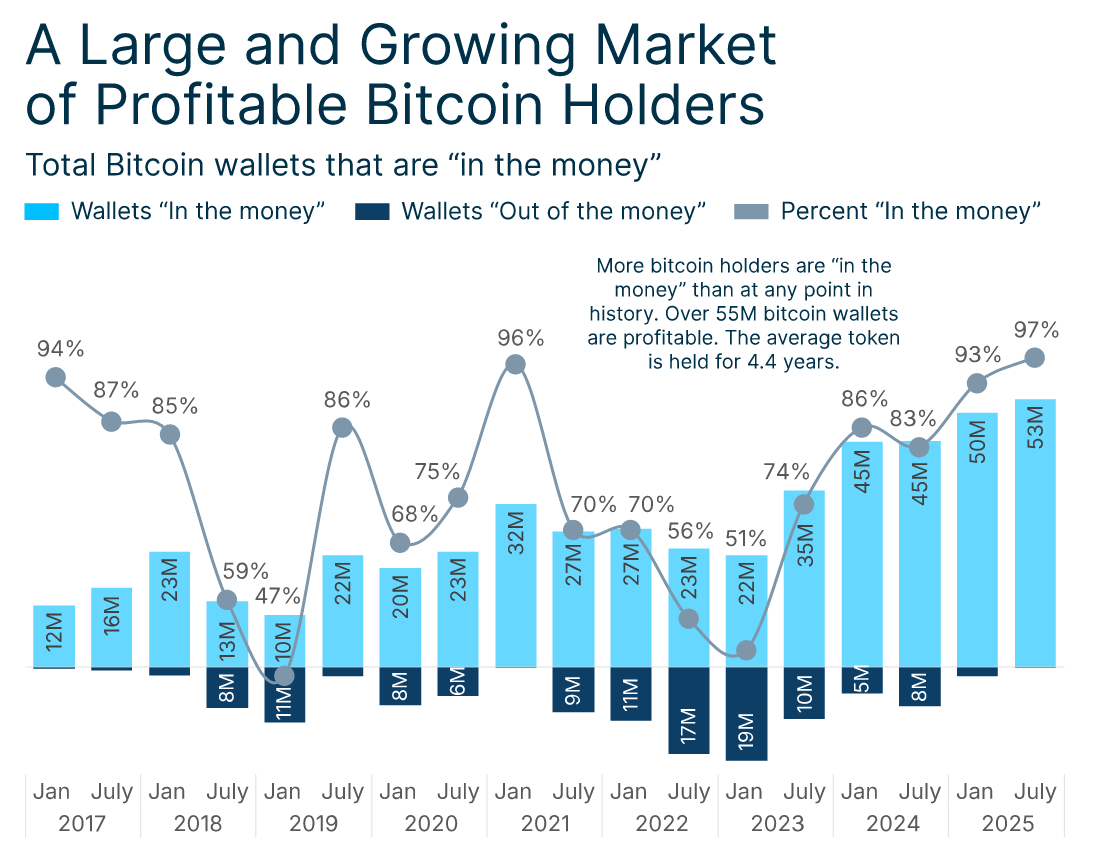
Fifteen years after launch, the leading cryptocurrency stands as the sixth most valuable asset on planet Earth—with a $2.4 trillion market cap, it outvalues the global silver market.D Today, more than 56 million wallets hold Bitcoin. For many, the last thing they want to do is sell.
But that doesn't mean they're not using it.
A new wave of builders is fulfilling Satoshi Nakamoto's original vision for Bitcoin, not just as a hedge, but as infrastructure for peer-to-peer financial services.
Three segments are now converging into a unified, bankable financial ecosystem, collectively moving billions in daily capital:
- Transparent Bitcoin-backed lending
- Lightning Network payments
- AI-powered financial automation
In this article, we explore key trends defining Bitcoin's emerging product era, drawing from on-chain activity and insights from exclusive interviews with founders and investors building the next generation of Bitcoin-native financial infrastructure. However, we can't boil the ocean here. This article is not about mining, price predictions, proliferation of Bitcoin rewards credit cards, or corporate treasury strategies, to name a few. We'll save those discussions for another time.
How does Bitcoin-backed lending unlock working capital?
The price of Bitcoin has surged since the 2022 bear market and a new wave of Bitcoin-backed lending platforms is offering access to capital with institutional-grade risk management. A new wave of collateralized loan products lets investors and companies borrow against BTC while preserving exposure.
The need for transparent, native solutions became critical after the collapse of centralized platforms like BlockFi and Celsius. Billions in user funds were lost due to custodial mismanagement and overleverage. But recent innovations in lending infrastructure have been designed to address those challenges.
Coinbase re-entered the lending market in early 2025 with an offering that allows users to borrow against their BTC, with real-time attestation of collateral reserves, facilitated by Morpho, a DeFi protocol. Strike also launched its own lending product in May 2025, enabling loans from $10,000 to $1B at rates as low as 9% APR.
The incentives to borrow instead of sell are strong. Borrowers can avoid triggering taxes on capital gains while retaining long-term exposure to Bitcoin, an asset that performs more like stocks than currency. The year-over-year value of Bitcoin has moved higher in 78 of the last 100 months, a rate nearly identical to the Nasdaq.D Many borrow to compound wealth while preserving their core asset.
"People don't want to sell their Bitcoin," said Robin Obermaier, founder of Liquidium, a decentralized lending platform. "There's a huge demand for liquidity, but the old model of wrapping Bitcoin and sending it to another chain is flawed. It introduces counterparty risk, technical complexity, and regulatory uncertainty."

 Article