Read next: The benefits of venture debt
How to size your debt facility
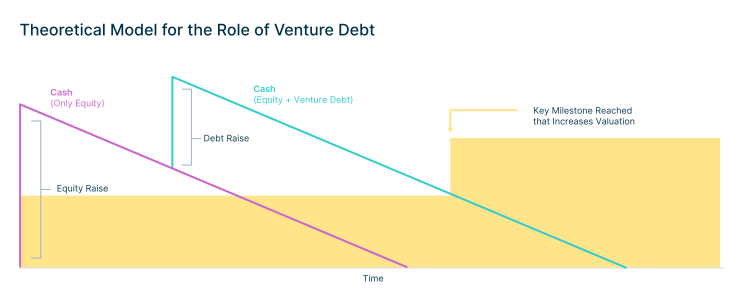
Given the advantages of venture debt in minimizing costs and dilution, it might seem logical that debt be the primary source of capital for high growth, later-stage startups. Yet, most capital should (and does) come from equity financing—with debt serving as a complementary tool.
Determining the optimal debt-to-equity ratio is a challenge every founder faces, and a decision we believe is more art than science. Still, there are certain metrics we consistently evaluate when sizing a debt facility for our clients:
1Debt to company size
A company's size is measured by annual recurring revenue (ARR) or gross profit. Companies that have consistent recurring sales are best benchmarked to ARR or other revenue metrics. On the other hand, a deep tech company is often best benchmarked to a measure of profitability such as gross profit given the product costs are far higher compared to software and revenue streams are often less predictable.
An acceptable amount of leverage is around 0.5x to 1x debt to ARR. While many lenders may exceed this amount, we advise against it as it could be detrimental to a company's ability to raise capital in the future.
2Debt to equity
This measures how much debt the company is taking on relative to the size of the last equity round (or sometimes total equity raised) and/or total equity raised to-date. It is often favored by bank lenders and measures debt's share of the capital stack.
We generally aim for a debt-to-equity ratio of 10-20%. That said, for many capital-efficient companies, the ratio might be as high as 100%, or even irrelevant as a benchmark.
3Debt to valuation
This metric, also known as loan-to-value or LTV, shows the loan as a percentage of the company's valuation. It is more commonly used by non-bank lenders.
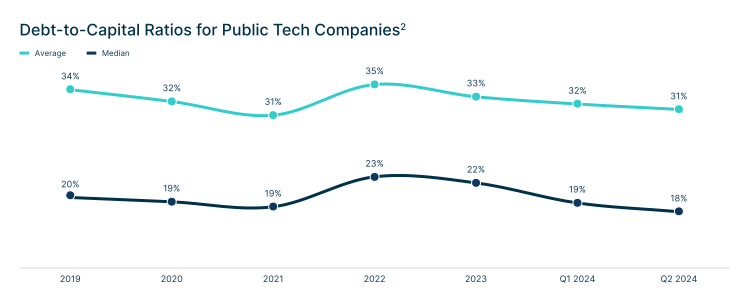
The benchmark for debt-to-valuation ratio has been volatile due to recent market fluctuations. Ideally, the debt shouldn't exceed 25% of the total valuation, and likely lower for companies with a potential valuation overhang.
Read next: How do lenders think about loan types?
Determining the right amount of leverage
Recently, given more competition in debt markets (from bank and non-bank lenders) and near-record dry powder among debt funds, lenders have begun offering ever larger commitments to companies. While these large quantums can be attractive to founders and investors, not to mention appropriate in some cases, it is important to avoid becoming over-leveraged. Taking on too much debt can hamstring a venture-backed company by limiting future fundraising, diluting shareholder value and potentially forcing a premature sale.
When determining optimal leverage, founders should keep these principles in mind:
Growth rate. High growth companies can take on more debt than those growing at a lower level, as they will more easily and quickly scale into the larger facility size as their valuation increases. Still, if top line performance doesn't meet expectations, the business can become over-leveraged compared to its size.
Revenue model. Companies with recurring sales, such as those with Software-as-as service (SaaS) or Hardware-as-a-service (HaaS) models, are often able to take on more debt as their revenue streams are more predictable than those operating with a one-time sales model. They also typically have the opportunity (generally) to generate higher cashflows over time.
Defensibility of IP. Companies that have more defensible intellectual property (IP) can generally take on more debt as they are insulated from a potential race to the bottom in terms of pricing when other companies compete, which can crush margins. Margin compression can lead to a scenario where the business is over leveraged.
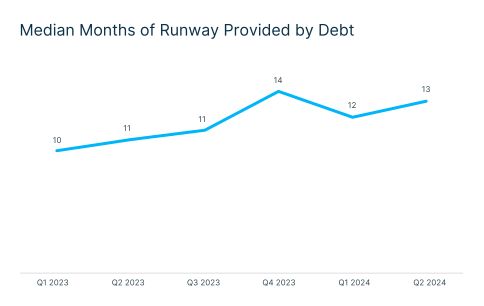
Burn rates and runway. Companies with high burn rates or low runway can quickly become over leveraged and do not have enough time to grow into key business milestones. If companies have high burn that is not mitigated by high efficiency (offsetting growth), equity should typically be the core funding mechanism.
Use case. Debt should be used to drive underlying growth in the business. If the company is drawing on the debt facility and is using the capital for non-value creating activities, the company can become over-leveraged.
Read next: What’s the right amount of venture debt?
Avoiding pitfalls
Thus, companies should be mindful about how much debt they need and should use. A trusted lending partner with a good reputation is important both in helping to determine optimal debt sizes and in following through on their commitments to the company. For instance, some lenders offer too-large debt facilities to entice borrowers. Making matters worse, many fail to follow-through on these commitments. Some use the material adverse change (MAC) clause to back out of their lending commitment if they feel something has materially changed in the business. Others may offer uncommitted accordion facilities, which require the borrower to request drawdowns from the facility they already have in place and permit the lender to not honor the request if they don't like the performance or do not have the actual lending capacity.
Read next: The “Four Cs” of choosing a venture debt lender
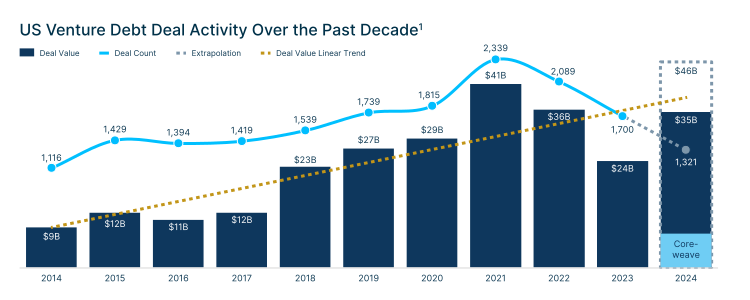
Every company's capital needs are unique. As the number of venture debt providers grows, at the time of this writing we expected debt volumes to continue to rise, with debt playing an increasingly important role in the financing strategies of top venture-backed companies.
Our Strategic Capital team, with a combined 90 years' experience in lending to innovative companies, partners with later-stage startups day in and day out to determine the role debt should play in helping them reaching their next milestones. Our flexible financing solutions including larger venture debt, mezzanine, private company convertible notes, cater to the diverse needs of growth stage companies.
As a lender who's seen it all throughout market fluctuations, we know there is one constant: Debt will continue to be a valuable tool in a VC-backed company's capital stack.




 Article