


Economic vista: Tariffs—it's different this time
Jon Schwartz, Portfolio Manager
Tariffs—those taxes or duties levied against various import items—are all over the news these days. The on-again, off-again status of tariffs is fueling volatility in financial markets as investors try to sort through the news and anticipate the ultimate ramifications that tariffs might have on inflation, interest rates, and the overall economy.
The case for tariffs is they are a tool to balance trade terms between trading partners. If you look at the United States' largest trading partners, China, Canada and Mexico make up approximately 40% of the goods imported to the country. More importantly, however, the US makes up a much larger portion of these three countries' exports. It is estimated that 78% of Canada's exports and 80% of Mexico's exports ultimately arrive on US soil, based on 2023 data. Such a lopsided trade imbalance gives the US substantial leverage when it comes to tariffs and negotiating trade deals. This was a significant factor during the tit-for-tat trade war that took place throughout most of Trump's first term. Tariffs and the retaliatory responses took many forms, particularly with China, including levies to aluminum, steel, solar panels, aircraft, automobiles, soybeans, chemicals and other imports, as well as outright bans on commerce with Chinese companies like Huawei. China continues to have the largest trade surplus with the US, as we buy far more Chinese goods than we sell into Chinese markets.
Digging a little deeper, we can see that in theory, tariffs have many possible uses. For example, instituting tariffs on China might help offset Chinese government subsidies that are creating a competitive advantage over US firms. President Trump ran on a platform that promised to ignite a manufacturing renaissance in the US and raising the prices of imported goods might encourage onshoring of manufacturing. Sometimes, tariffs can be used as leverage to drive other outcomes as well. Tariffs against our neighboring trading partners, Mexico and Canada, may be used to tighten borders, address immigration and even help slow the flow of fentanyl and other illegal drugs to the US.
Uncertainties abound
Although financial markets often react immediately to the latest news, we must come to terms with the fact that we may not learn important details regarding tariffs—the duration, the size of levies, the goods that might be excluded—for some time. Behind the scenes negotiations are always ongoing. And the reality is that the situation is inherently fluid. Such uncertainty not only roils markets, but it can cause real economic friction, which can lead to stalling or reducing business investments and even eroding consumer confidence.
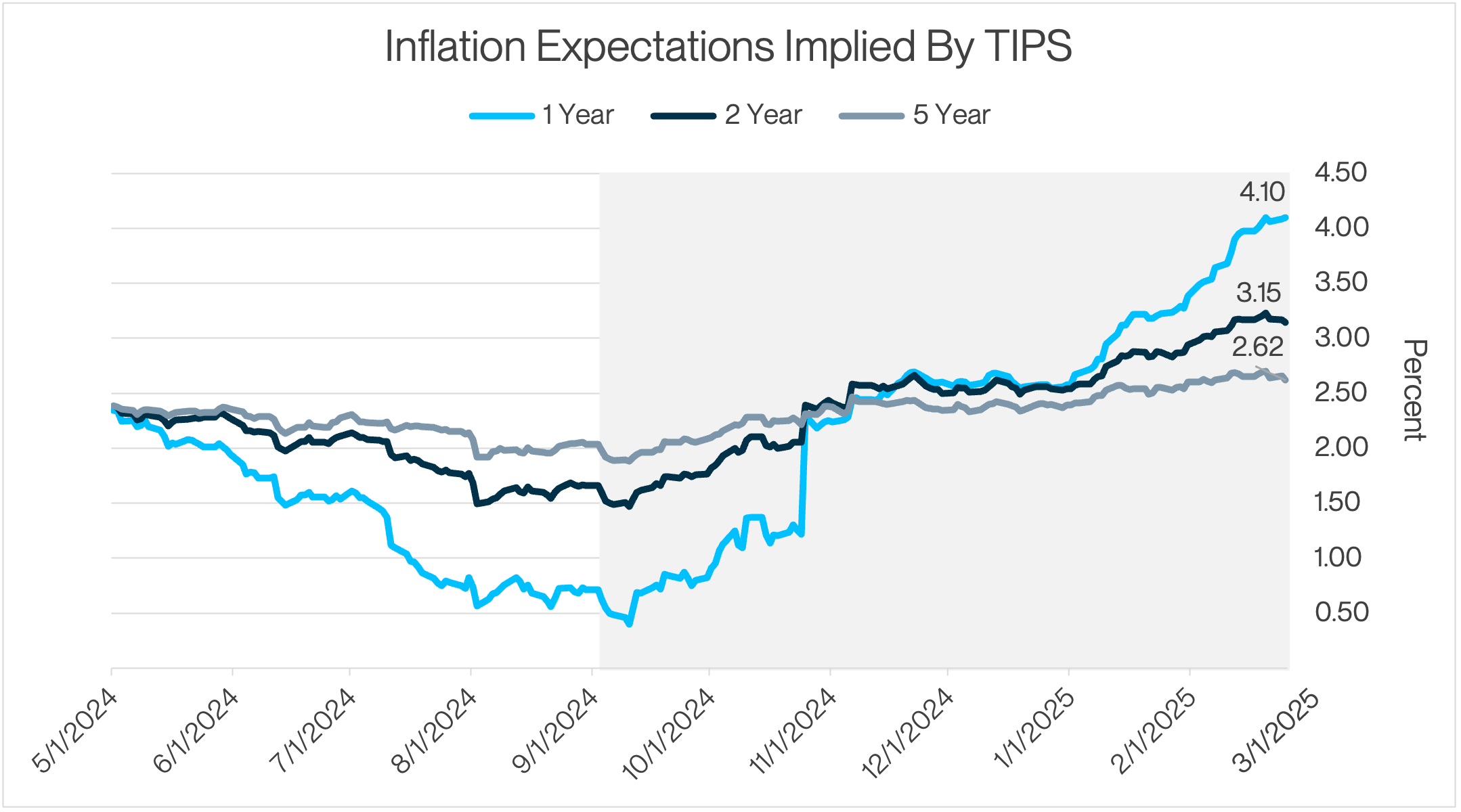
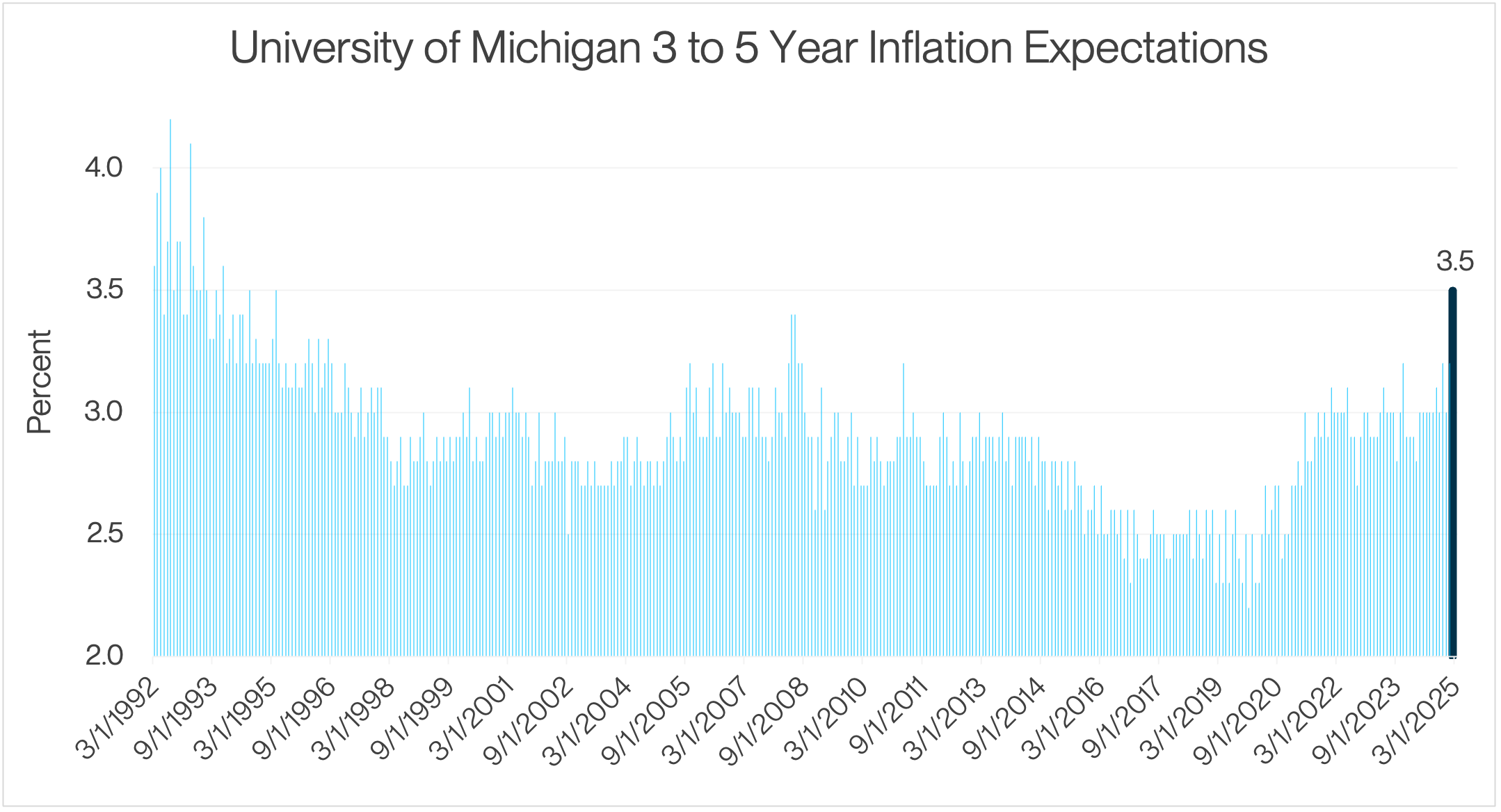
Perhaps even more than economic uncertainty, many investors are focused on the fact that increased prices due to tariffs could have a very real impact on inflation and inflation expectations. The uptick in inflation expectations can be seen when we study Treasury Inflation Protection Securities (TIPS). TIPS are basically US Treasuries with the yield adjusted by what inflation is expected to average over the investment horizon. For example, looking at 1-year TIPS, we can see the US Treasury rate is 4.18%, while the 1-year TIPS are trading at 0.08%. This implies that CPI is expected to average 4.10% over the next 12 months. But remember, there are other variables at play, such as supply constraints for TIPS and other factors. Still, the trend in expectations for higher inflation in the near- and longer term is quite clear when looking at 1-, 2- and 5- year TIPS.

 Article