Read more about our corporate brand here.

Search
Consumer Internet

Venture investment in consumer internet: Q4 update

An (almost) end-of-year review of investment trends among US consumer internet companies
Alicia Fuller, Nicole Hawkey, Josh Pherigo

Key takeaways

  • VC investment in consumer internet is up 25% from 2023's nine-year low, with later-stage VC up 83% year-over-year.
  • A stable of consumer internet unicorns await an exit. At least 100 consumer tech unicorns are active, with nearly half gaining that status in 2021.
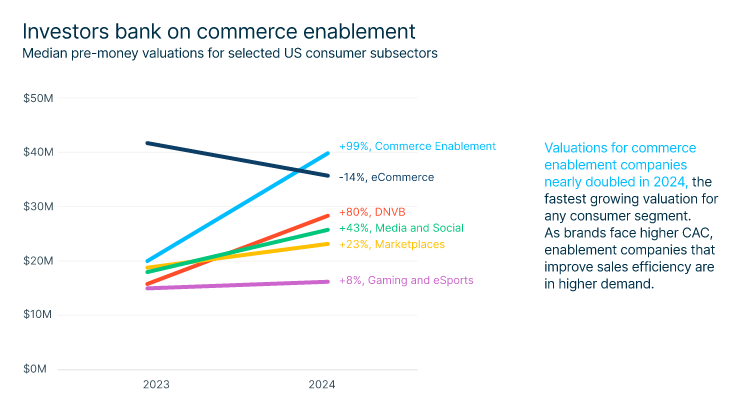
  • While eCommerce companies struggle, commerce enablement saw median valuations spike 99% in 2024, the most among any consumer segment.

An (almost) end-of-year review of investment trends among US consumer internet companies

Among all tech sectors, consumer internet companies face perhaps the toughest startup journey. Shifting tastes, fleeting attention spans and saturated markets make winning and retaining customers a daunting proposition, even in the best of times. And these are not the best of times. Sky-high customer acquisition costs and a growing sense of digital fatigue are now straining companies that were thriving just three years ago, pushing some investors out of the space entirely.

Yet, for investors with the conviction to remain, a massive amount of value could be up for grabs. Consumer internet has created the most lasting and recognizable brands in tech and still offers lucrative opportunities. US consumer spending accounts for two-thirds of GDP, yet consumer internet companies draw less than seven percent of VC investment, down from 30% a decade ago. In this article, we'll examine this widening vacuum of investment and other trends that are shaping the future of consumer internet just as AI begins to transform it.

1Consumer investment bounces off the bottom

Consumer startups are still feeling the hangover from the VC boom of 2021, but signs of a recovery are growing. VC investment in the sector is up 25% from 2023's nine-year low, with the rebound most pronounced at the later stage. After grinding to a near-standstill last year, Series B to D investment is up 83% year-over-year, driven by a handful of mega deals. Investments over $100M account for 55% of late-stage investment in 2024, up from 37% last year. With deal flow now trickling toward an 8-year low, investors are consolidating their late-stage capital in the most promising companies in each sector.

Fortnite creator Epic Games leads all consumer internet companies with $425M raised in July and a $1.5B investment from Disney that was announced in February and is awaiting approval. The deal would put gaming among three consumer internet subsectors that have doubled their late-stage investment total this year, including media/social networking and commerce enablement. E-Cigarette maker Juul added to its mountain of raised capital with a $1.2B late-stage round in May, the largest single deal in a consumer sector.

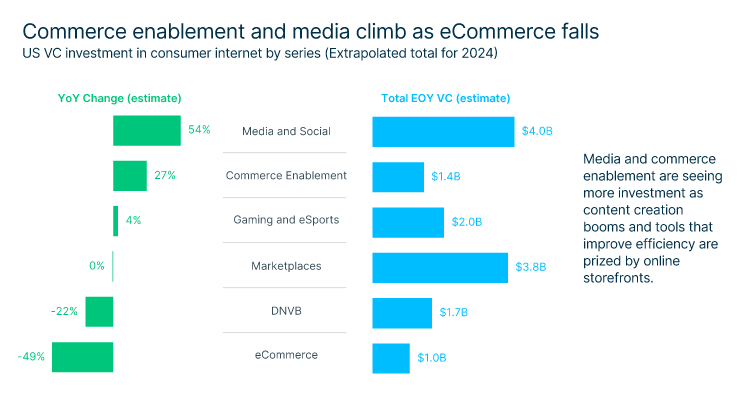
The social media startups generating special interest from investors are those seeking to add value beyond the screen, either by offering tools for creators to capture more of the value they generate, such as the platform Social Display, or by bringing users into the real world, such as the AI-powered social platform Infinite Reality—both companies closed $350M deals in July. In the near-term, eCommerce and digital-native brands remain oversaturated, though we expect continued strength in media, social and commerce enablement.
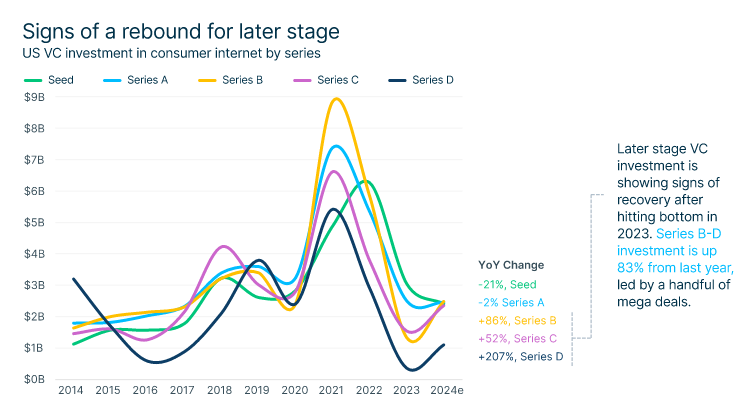
A line chart illustrates US venture capital investment in consumer internet companies by funding series from 2014 to 2023 Note: VC investment for 2024 is a year-end extrapolation of the current year-to-date trend. The data excludes unlettered rounds. Source: PitchBook Data, Inc. and SVB analysis.
Infographic showing changes in US VC investment in consumer internet by sector Note: Segments according to SVB taxonomy. Data is the end of year extrapolation of the YTD trend as of 9/27/2024. Source: PitchBook Data, Inc. and SVB analysis.

2Commerce enablement sees valuations spike

While eCommerce companies struggle with higher customer acquisition costs and higher price-sensitivity among consumers, companies with products that help streamline operations are faring well. Commerce enablement saw median valuations spike 89% in 2024, the most among any consumer segment. Among notable enablement deals:

  • End-to-end eCommerce platform Cart.com raised at a $1.1B pre-money valuation, a 2x step-up from its valuation in 2021;
  • Butter, an enablement company that reduces unintended customer churn, saw a 1.3x step-up to $125M pre-money value from 2022;
  • Akia, an engagement platform that optimizes hotel check-ins, was valued at $40M at a 2x step-up from its seed round just last year.

These companies highlight a trend of continued growth we expect for enablement companies, as eCommerce continues to be a competitive space.

Slide-style graphic showing a line chart of median pre-money valuations for selected US consumer subsectors from 2023 to 2024 Note: Sectors according to SVB taxonomy. Source: PitchBook Data, Inc. and SVB analysis.

3Crypto and gaming unite

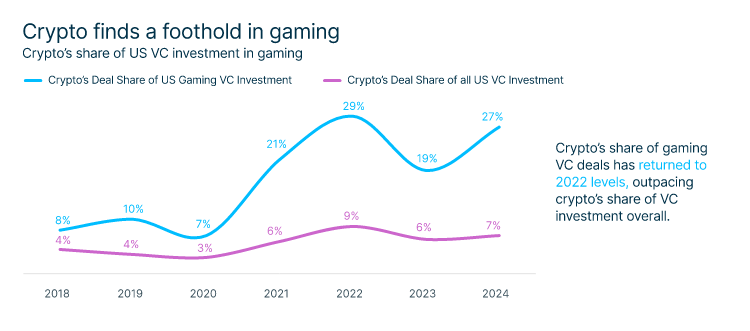
Blockchain is becoming an integral part of gaming, both as an enhancement to traditional games and as a foundation for standalone projects. This year's resurgence in crypto prices has rippled into gaming, with 27% of gaming VC deals going to companies using blockchain, up from 19% last year. Notable players like Sky Mavis and Animoca Brands are pioneering this space, integrating blockchain to create more immersive gaming experiences. Crypto's concentration in gaming is nearly 4x its share of VC overall and likely to grow as play-to-earn gaming, the tokenization of in-game assets and the promise of inter-game interoperability continue to rise in popularity.

A dual-line chart illustrates crypto’s share of US gaming VC investment versus its share of overall VC investment from 2019 to 2024 Note: Data as of 9/24/2024. Source: PitchBook Data, Inc. and SVB analysis.

4An AI advantage for later-stage companies

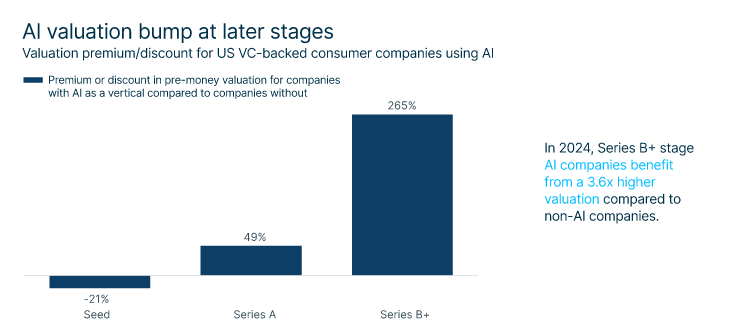
For consumer companies, we've observed that the presence of AI does not make a huge impact on early-stage valuations. However, its significance may be a differentiator as companies advance through the funding pipeline. At later stages, consumer AI companies have a significant valuation premium over companies without an AI offering. For Series B+ companies, those integrating AI into their core products have a 265% valuation premium compared to companies without AI as a core component. Notably, this is a reversal from what we've seen in other sectors, where AI is helping to boost earlier-stage valuations more than later-stage ones. We don't know for sure why the trend is different for consumer, but it may simply come down to revenue. Since consumer valuations are more grounded to sales than other sectors, it's possible that early-stage AI companies have less revenue, while at later stages, the best companies have implemented AI.

Fundamentally, AI is already boosting margins for consumer companies. Automation tools, such as improved conversational AI, help lower customer acquisition costs. While chatbots were once cutting edge, they are now evolving into more human-like conversations, with smarter computer-generated responses and AI-driven engagement. 

Implementing AI into existing products is a challenge that founders are approaching thoughtfully. Abhi Ramesh, founder and CEO of Misfits Market said his company has applied large language models (LLMs) to their existing data, helping to drive down costs by as much as 70% over the past two years. "For inventory and pricing, AI algorithms help streamline our warehouse back-end and back-office processes. On the front end, our model uses machine learning to pre-populate carts by analyzing user behavior, allowing customers to focus on the 'fun stuff.'"  

 A bar chart illustrating valuation premiums or discounts for US VC-backed consumer companies using AI Note: All non-AI consumer VC-backed deal pre-money valuation median ($M) and AI consumer VC-backed deal pre-money valuation median ($M). Data as of 9/13/24. Source: PitchBook Data, Inc. and SVB analysis.

5Investors shift focus

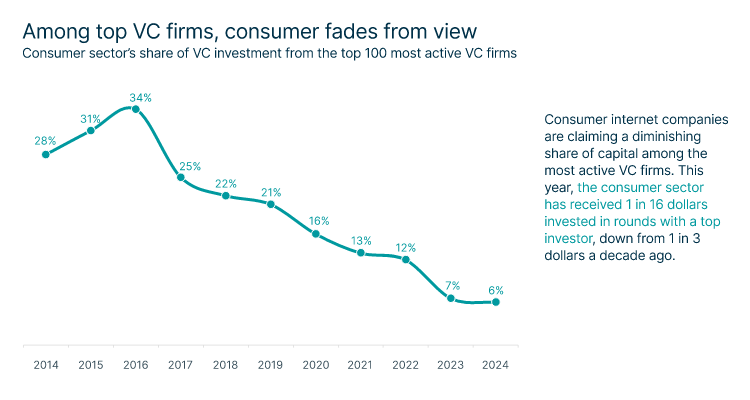
While consumer tech was once a central focus of the largest VC firms, sector-agnostic funds are increasingly pulling back from the space, instead choosing to allocate more investment into the more predictable revenue stream of enterprise software, which includes many AI companies. Notable recent departures of consumer-focused GPs at firms such as Andreessen Horowitz underscores the shift away from traditional consumer tech companies toward AI investments. Among the top 100 most active VC firms, consumer companies accounted for just 6% of investment in 2024, half the share from two years ago. The shift continues a long-term trend of consumer tech losing market share to enterprise tech.  

Previously, consumer seed deals outnumbered enterprise 2:1, but that ratio has now reversed. Does this spell doom for the consumer tech segment as we know it? We don't think so. For contrarians, the growing vacuum in funding creates opportunity to find value across the distribution of companies, below the top quartile of valuations. 

One thing is for sure: The lines are blurring in how we think about the consumer space. Digital-native consumer brands aren't going away, but the pressure is on for many of them to either become profitable or to differentiate themselves with something truly unique. Firms that might have invested into an e-commerce company are shifting investment into enterprise companies that are adjacent to consumer brands—AI startups creating customer service applications, for example. This shift is squeezing the available capital for existing consumer startups, which may face a tougher path to exit if they can't become profitable.  

A teal line chart illustrates the declining share of consumer sector VC investment among the top 100 most active VC firms from 2014 to 2024 Note: Based on the value of deals in which a top 100 investor participated in the round. Most active investors are gauged by deal count over the last five years with a minimum median fund size of $100M and VC as the primary investment type. Source: PitchBook Data, Inc. and SVB analysis.

6Early-stage dynamics

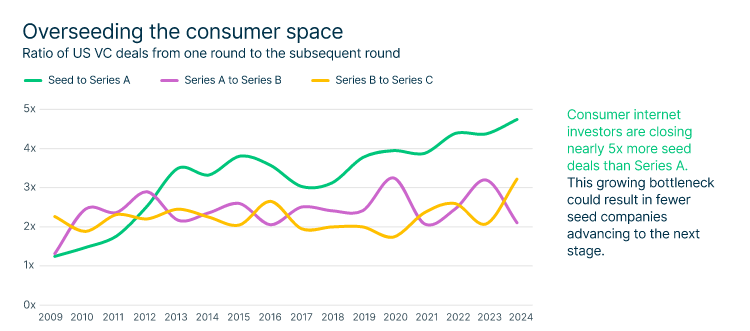
With later-stage dynamics especially challenged, early-stage funding in the consumer space has taken a larger share of deals, though actual deal numbers are now falling off. Investors are closing nearly five times more seed deals than Series A, creating a bottleneck in the startup pipeline. The trend is even more pronounced in consumer than in the larger VC ecosystem, where three seed deals are being closed for every Series A. As the number of consumer VC deals tracks toward an 8-year low, many of these seed companies face uncertain futures, pressured to show traction as only the most scalable will secure follow-on funding. On a positive note, investment is beginning to rebalance. In 2023, seed and Series A investments made up 58% of consumer deals, nearly double its historic share. This is now correcting itself, with 45% of deals in early-stage investments this year.

Horizontal infographic line chart titled "Overseding the consumer space" shows the ratio of US VC deals from one round to the subsequent round Note: Analysis includes all lettered deals, including extension round or multiple deals for the same companies. Source: PitchBook Data, Inc. and SVB analysis.

7Exit-ready unicorns

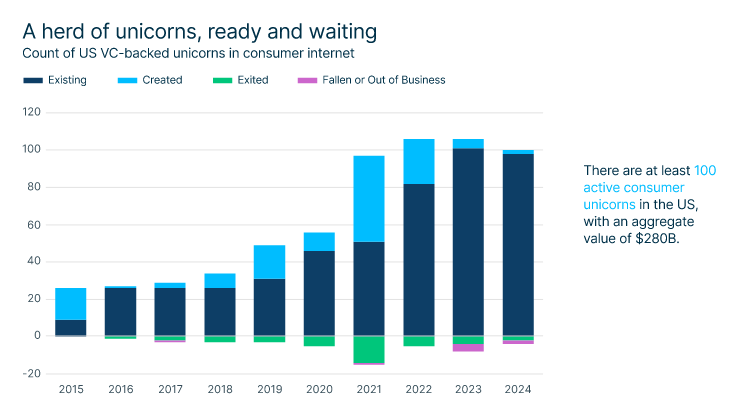
The IPO window has remained largely closed for nearly three years, leaving many late-stage consumer companies stranded and waiting for an exit. Consumer IPOs raised over $14B in capital in 2021, dwarfing the $4.7B raised since. There are at least 100 active consumer unicorns in the US, accounting for upwards of $280B in locked liquidity waiting on the sidelines. Liquidity events for these companies would return capital to investors and help restart the flywheel of innovation in the space. Many of these companies could make strong candidates for an IPO, following in the footsteps of several VC-backed consumer companies that bucked the trend to go public during the IPO drought. Reddit, CAVA and Instacart are all trading up from their IPO price, which could instill confidence in other tech unicorns. However, the success of their IPOs and their stock performance since exiting have been mixed.

Horizontal bar chart visualizes the count of US VC-backed consumer internet unicorns from 2015 to 2024 Source: PitchBook Data, Inc. and SVB analysis.

Consumer unicorns that are growing ripe (or over-ripe) on the vine will have to weigh their options carefully. For companies that don't have the metrics to IPO, an M&A transaction may provide an outlet. According to our recent State of the Markets report, nearly 30% of US VC-backed tech unicorns are now unprofitable and shrinking. These companies will be hard pressed to raise additional capital from growth investors but may find opportunities in M&A transactions. 

To dig further into the data, please reach out to your SVB contact, or send us a message here.

Find out how we help consumer internet companies accelerate their growth.

Read next

Explore these related articles to help you stay on top of the latest data, industry insights and developments in consumer internet.

Front-end bond yields and short-duration fixed income Fixed Income Strategy
Read Article Article

Front-end bond yields and short-duration fixed income

Sep 29, 2026

Steve Johnson, Timothy Lee

The Expansion of Space Tech: To Infinity and Beyond Aerospace and Defense
Read Article Article

The Expansion of Space Tech: To Infinity and Beyond

Sep 22, 2026

Kyle McQuighan, Ryan Larson

Capitalize on low option costs for FX hedging FX Risk Advisory for Corporates
Read Article Article

Capitalize on low option costs for FX hedging

Sep 16, 2026

Irwin Bautista, Grayson Prickett

More about the authors

Alicia Fuller

Alicia Fuller

Senior Market Manager

Nicole Hawkey

Nicole Hawkey

Managing Director

Josh Pherigo

Josh Pherigo

Principal Researcher, Market Insights


This information is provided for educational purposes only and should not be relied on or interpreted as accounting, financial planning, investment, legal or tax advice. First Citizens Bank (or its affiliates) neither endorses nor guarantees this information, and encourages you to consult a professional for advice applicable to your specific situation. Third parties mentioned are not affiliated with First-Citizens Bank & Trust Company.

All third-party trademarks referenced by First Citizens Bank remain the property of their respective owners. First Citizens Bank’s use of third-party trademarks does not indicate any relationship, sponsorship or endorsement between First Citizens Bank and the owners of these trademarks. All references by First Citizens Bank to third-party trademarks are to identify the corresponding third-party goods and services and intended to constitute nominative fair use under applicable trademark laws.

This material is for informational purposes only and is not intended to be an offer, specific investment strategy, recommendation, or solicitation to purchase or sell any security or insurance product, and should not be construed as legal, tax, or accounting advice. Please consult with your legal or tax advisor regarding the particular facts and circumstances of your situation prior to making any financial decision. While we believe that the information presented is from reliable sources, we do not represent, warrant, or guarantee that it is accurate or complete.

Back to top
You are now leaving First Citizens Innovation Banking

You will be directed to a different website or mobile app that has its own terms of use, visitor agreement, security and privacy policies. First Citizens Innovation Banking is not responsible for (and does not provide) any products, services or content at the third party site or app, except for the products and services that carry the First Citizens Innovation Banking name.