
Key takeaways
- Companies improve working capital by gaining "float" with virtual cards
- The adoption of virtual cards creates per-transaction cost savings
- ERP integration and real-time data are key advantages of virtual cards


As high-growth companies navigate a volatile economic environment, optimizing working capital is more essential than ever. Finance leaders are working hard to ensure that capital is deployed for strategic initiatives that drive key performance indicators. At the same time, they need to eliminate manual processes that slow teams down and drive-up costs. Innovation economy companies focused on efficiency are using virtual cards to capture business value on multiple levels.
As our clients scale, they face a growing need for flexibility as more employees spend on behalf of the company for travel, software, lab supplies and work-from-home equipment. Plastic cards can be useful on the go, but virtual cards enable you to enhance your commercial card program to better meet dynamic spending needs.
94% of firms that use virtual cards say their transactions are faster, more detailed and more secure.
Using virtual cards for business needs, I've seen clients unlock value in four important ways:
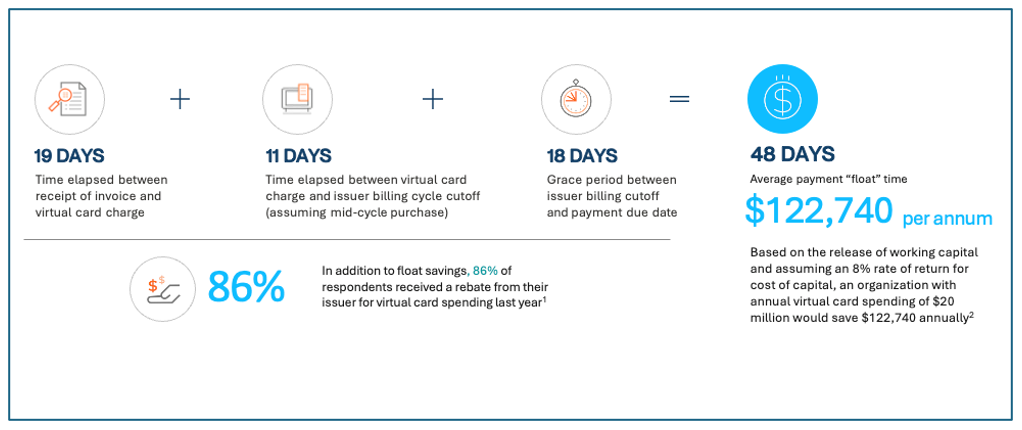
One way to optimize working capital is to maximize the number of days between when you incur a cost and have to pay out the funds. Many cards have a 30-day billing cycle, and some include an added grace period, which gives you more "float" time until you have to pay the balance.
Consider this example from Mastercard's RPMG Virtual Card Benchmark Survey in 2022D. They illustrate that $20 million of virtual card spending that has 48 days of float could save $122,740 annually. And there may be additional savings from cash back rewards or revenue sharing. In fact, 83% of companies surveyed agreed that virtual cards enhanced their position for optimizing working capital.
Example based on RPMG Virtual Card Benchmark Survey (2022)
While physical credit cards also offer float, with instant issuance and granular spending controls, you gain an extra edge.
In fast-growth companies, everyone has a lot on their plate. Meanwhile, inflation, supply chain disruptions and a volatile economy are driving up operating costs. That's why it's critical to create efficiencies that enable your finance team and employees to use time and money wisely, so the organization can control spending and stay focused on strategically valuable work
One easy win to help reduce costs is using virtual cards for business needs. Compared to legacy payment methods, virtual cards create more per-transaction cost savings that can really add up. For example, an organization with 575 monthly virtual card transactions may see savings of $1,725 to $14,375 per month in transaction-related costs, according to the RPMG report noted earlier.
On top of savings, virtual cards deliver significant efficiency gains by automating workflows from issuance and approvals to reconciliation and syncing to your ERP.
You can seamlessly integrate virtual card data directly into your ERP or accounting systems. When you issue a card, you can embed key data—like GL codes, cost centers and project tags. With the upfront coding of transactions, you eliminate time-consuming manual tracking and guesswork and reduce errors and associated risks. It empowers your organization with a highly efficient and accurate automated reconciliation process.
Our clients also find it valuable to take advantage of daily transaction data. A centralized dashboard equips them with a real-time environment of reporting insights for better decision making.
Your suppliers also benefit when they accept virtual cards. The richer data can enable straight-through processing, with transactions that flow into their accounting system without the need to rekey. They also receive guaranteed payments, with the money deposited into their account and reconciled more quickly than with checks.
Yet another strategic advantage of using virtual cards for business spending is that they include inherent security benefits, such as:
Building precise spend controls into each virtual card means you get policy compliance by design. You don't need to waste time resolving out-of-policy spend or chasing down receipts after the fact.
Virtual cards also help you avoid the escalating risk of check fraud – which continues to skyrocket. A Nacha report noted that, "Even as check processing volume at the Federal Reserve declined 8%, AFP [Association of Financial Professionals] pointed to a 40% increase in check-related Suspicious Activity Reports filed with the Financial Crimes Enforcement Network."
Virtual cards help your finance team and card program administrators efficiently manage growing headcount and increasing purchasing needs while reducing your workload. Automated provisioning and card management, AI-powered spend management, and ERP integration enable simpler, faster, more effective workflows.
By optimizing cash flow, cutting costs and bolstering confidence in the face of potential fraud and risk, you can see why we think virtual cards may be the ultimate working capital tool.
If your company manages your working capital by borrowing, the benefits may be even greater. We can't cover it all here, but reach out to learn how you could achieve a significant cash surplus through virtual card adoption.
Want to learn more about SVB's corporate cards and virtual cards? See how we combine technology solutions with in-depth expertise to help you save time and money.
Explore these related articles to help you stay on top of the latest data, insights and developments in the venture-backed crypto and blockchain ecosystem.
 US Treasuries
 Article
Oct 28, 2026
Jose Sevilla, Jason Graveley
 Global Trade Finance
Article
Oct 26, 2026
Justine Nguyen, Dennis Brown
 Spend Management
Article
Oct 23, 2026
Angela Sellers