Read more about our corporate brand here.

Search
Search
Corporate Card

Essential corporate card metrics every business should track

Brian Kass
September 17, 2025

Key takeaways

  • Use corporate card KPIs to reveal how you can gain more benefit across your organization.
  • Start with metrics that provide baseline insights to optimize the card program.
  • Answer key questions like how well your card program is implemented, utilized and increasing control over total spend.

Why corporate card metrics matter for program success

As your company races toward your next level of growth, it's mission critical to have clear insights about spending. You need to avoid a moment of truth like discovering that your employees are still using personal cards, and the resulting lack of visibility has put your meticulously prepared cash forecast in jeopardy.

That's why it's crucial to run some corporate card metrics to measure how extensively your commercial card program is being used across your organization.

What should you measure? I often recommend that clients start with corporate card KPIs that help determine whether the foundation of your card program is solid. That gives you baseline insight into how you might further optimize the program to return more tangible value back to the business.

With that in mind, let's look at three metrics that answer fundamental questions: Are cards in the right hands? Are people actually using them? And how much of your company spend is controlled efficiently through your card program?

3 corporate card KPIs to measure your program

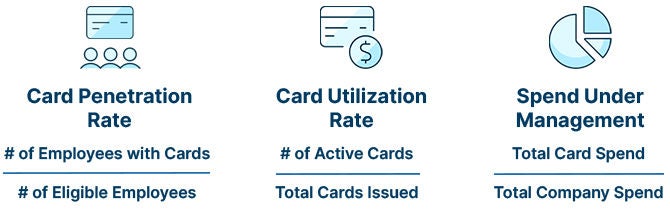
Infographic depicting corporate card performance and spend metrics

1. Card Penetration Rate

Start by measuring how widely distributed your corporate cards are. Because Card Penetration Rate looks at total cardholders vs. eligible employees, it can help you identify if the right people have cards. Companies often focus on procurement managers or department heads, senior executives and business travelers. However, this metric may prompt you to consider other employees who can benefit from having a company card.

For example, when it comes to life sciences companies, you might also want to include scientists and lab managers. The last thing you want is for work to grind to a halt because you ran out of pipette tips or culture media. Yet you also don't want staff buying supplies on their personal card and having to manually create expense reports for every little thing. Fast-moving companies leverage a card program integrated with spend management to seamlessly issue customized cards and automate expense reporting so everyone stays productive.

Formula: (Number of employees with cards) ÷ (Total eligible employees)

A high penetration rate indicates successful adoption, which is a sign that you're ready to grow the card program further. A low rate, however, could signal the need to onboard more eligible employees.

2. Card Utilization Rate

Utilization is an important measure of card program success. That's why your next metric identifies how actively corporate cards are being used.

Formula: (Number of active cards) ÷ (Total cards issued)

High utilization rate indicates employees are regularly using their cards to meet business needs, and the finance team has visibility and control over that spend. It also implies you're maximizing value in cash back revenue and cost-saving efficiencies, and that's a healthy position for scaling the program.

Low utilization may mean that cardholders are using personal cards or alternative payment methods, which makes spend management more complicated. Often employees don't know which purchases are allowed, or out of habit they default to using their personal credit card. This robs your company of real-time insights and forces your finance team into a reactive position.

Engage employees to ensure they understand your spend policies. Even better, take advantage of a corporate card program that allows you to set custom limits, categories and expense codes for each cardholder. You can also supplement plastic with virtual cards. That way, staff will see automated alerts as guardrails if they attempt to use the card in a way that's not in-policy.

3. Spend Under Management

I also suggest clients look at Spend Under Management. This corporate card KPI identifies how much of your total company spend is flowing through your card program.

Formula: (Corporate card spend) ÷ (Total company spend)

Ideally, you want this ratio to be higher because it indicates that you are capturing more of the available value for your business. With a card program integrated with robust spend management, such as the SVB Innovator Card, you gain better cash flow forecasting. This combination offers real-time visibility, card controls and automated expense reporting. And you support growth with more cash back or rewards points and cost-efficient workflows.

Higher Spend Under Management also boosts your ability to leverage spend data for making strategic decisions and negotiating better rates with vendors.


Measuring the impact of your corporate card program enables you to demonstrate that you're building scalable financial processes from the beginning. It signals that you're putting the right levers in place to help drive growth.

Ready to optimize your corporate card program? Learn how SVB corporate cards with AI-powered spend management can fuel your innovation journey.

Frequently asked questions

Series A companies should review corporate card KPIs monthly to track penetration and utilization rates. For managing cash flow, you might want to check Spend Under Management on a weekly basis. As you scale toward Series B, consider tracking the other card metrics weekly as well.

Ideally, your corporate card program should have a utilization rate of 75% or higher. It indicates your commercial card is being used for most expenses, which helps deliver more value back to the business. Below 50% suggests employees may still be using personal cards that provide no visibility or control over that spend. Consider issuing virtual cards customized for specific users and use cases to centralize more spend on your card program and make it easy for people to stay on-budget and in-policy.

Strong corporate card metrics indicate you are effectively leveraging your card program to capture ROI through cost-saving automation, cash flow optimization and cash back revenue. Increasing visibility and control over spend, and reducing manual work, help empower sustainable growth.

Read next

Explore these related articles to help you stay on top of the latest data, insights and developments in the venture-backed crypto and blockchain ecosystem.

Treasury market infrastructure: How it shapes corporate cash investing US Treasuries
Read Article Article

Treasury market infrastructure: How it shapes corporate cash investing

Oct 28, 2026

Jose Sevilla, Jason Graveley

Using a Standby Letter of Credit for a commercial lease to support real estate expansion Global Trade Finance
Read Article Article

Using a Standby Letter of Credit for a commercial lease to support real estate expansion

Oct 26, 2026

Justine Nguyen, Dennis Brown

Startup expense management: Moving from manual processes to scalable controls Spend Management
Read Article Article

Startup expense management: Moving from manual processes to scalable controls

Oct 23, 2026

Angela Sellers

More about the authors

Brian Kass

Brian Kass

Senior Card Advisor, Global Treasury & Payments Advisory


The views expressed in this article are solely those of the author and do not necessarily reflect the views of First Citizens Innovation Banking.

All non-SVB named companies listed throughout this document are independent third parties and are not affiliated with Silicon Valley Bank, a division of First-Citizens Bank & Trust Company.

This material, including without limitation to the statistical information herein, is provided for informational purposes only. The material is based in part on information from third-party sources that we believe to be reliable, but which has not been independently verified by us, and, as such, we do not represent the information is accurate or complete. The information should not be viewed as tax, accounting, investment, legal or other advice, nor is it to be relied on in making an investment or other decision. You should obtain relevant and specific professional advice before making any investment decision. Nothing relating to the material should be construed as a solicitation, offer or recommendation to acquire or dispose of any investment, or to engage in any other transaction.

All credit products and loans are subject to underwriting, credit, and collateral approval. All information contained herein is for informational purposes only and no guarantee is expressed or implied. Rates, terms, programs and underwriting policies subject to change without notice. This is not a commitment to lend. Terms and conditions apply.

Banking, lending and trust products or services are offered by Silicon Valley Bank, a division of First Citizens Bank. Member FDIC.

Back to top
You are now leaving First Citizens Innovation Banking

You will be directed to a different website or mobile app that has its own terms of use, visitor agreement, security and privacy policies. First Citizens Innovation Banking is not responsible for (and does not provide) any products, services or content at the third party site or app, except for the products and services that carry the First Citizens Innovation Banking name.