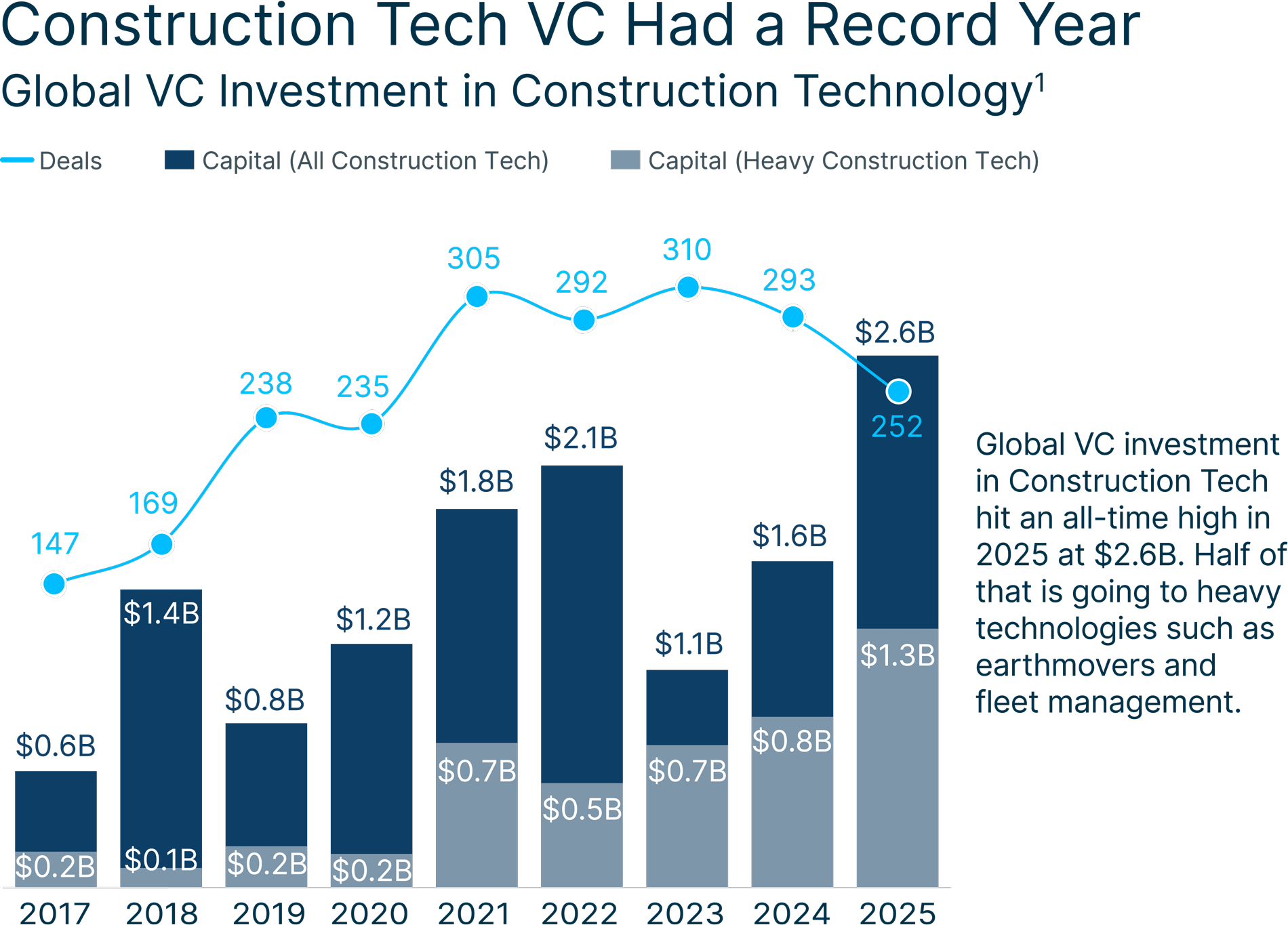
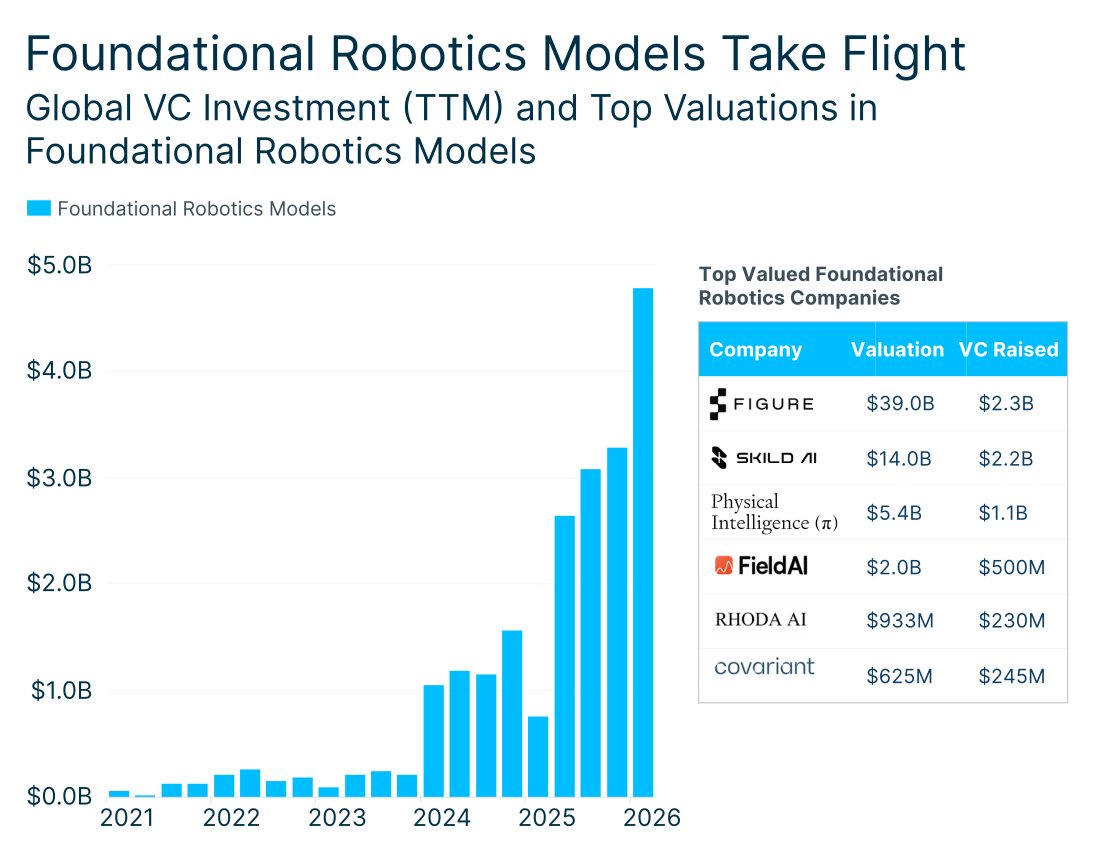
FieldAI is one such example, alongside a growing cohort focused on embodied intelligence. Total VC investment in companies developing foundational robotic models reached $4.8 billion over the last four quarters. FieldAI has raised over $500 million to develop embodied AI models. Its systems act as robot brains, guiding machines through three-dimensional environments while managing risk and safety.
"Traditional models and traditional approaches were never designed to manage that risk," FieldAI CEO Ali Agha told TechCrunch.
3. Hardware advancements are making real world AI viable
Even the most robust AI models are only as strong as the hardware that underpins them. Two transformational hardware shifts are proving key to unlocking industrial autonomy.
Commoditized hardware
The first hardware shift is the commoditization of sensors. Over the last several years, the cost of cameras, light detection and ranging (LiDAR), radar cameras and inertial measurement units has fallen sharply, while performance has improved. Early autonomous vehicles in the mid-2010s relied on LiDAR that cost $75K or more. Today, advanced LiDAR systems sell for under $1K. Costs that were once prohibitive have given way to affordable components, making autonomy viable for many more machines.
Components that formerly required custom engineering are now available off the shelf. For example, instead of fitting conventional cameras with custom-made housings to reduce dust and glare, companies can now buy ruggedized cameras that require little to no modification.
As hardware has become cheaper and more modular, it no longer needs to be permanently embedded into machines. It can be easily moved between assets and upgraded over time.
For AIM, this flexibility is important, Sadilek said. The company’s retrofit system fits in a Pelican case, as easily deployable on a fleet of mining earthmovers today as it might be on a fleet of intercity snowplows tomorrow.
"The key is end customer success," said Sadilek. "The AIM solution doesn't make any assumptions as to what sensors or compute may or may not already be on the vehicles. The customer has a lot of power and optionality in how to automate their operations in a way that works for them."
Edge and fog computing
In addition to cheaper parts, the second hardware shift is the rise of edge and fog computing. Heavy machinery cannot depend on cloud-based reasoning alone. Job sites often have unreliable connectivity, and many decisions must be made in milliseconds. New generations of specialized chips make it possible to run planning and safety systems directly on the machine, even in weather-exposed environments.
In edge computing, intelligence is processed by computers on the machine. A bulldozer detecting a large rock in the pathway, a robotic arm sensing and adjusting its reach to avoid an oncoming dump truck — these kinds of actions take split-second decisions that can't be outsourced to the cloud or a nearby server. Conventional CPUs are too energy-intensive and slow to be reliable for edge computing, but new AI accelerator chips are up to the task. NVIDIA's Jetson Thor is a gamechanger in this realm, purpose-built for real-time decision-making.
Released in 2025, the Jetson Thor chip can deliver roughly two quadrillion tera floating point operations per second of AI compute. That's a 7.5x increase in performance over the previous generation of chips released just two years prior. These powerful chips can enable the complex world models needed for embodied AI. Notably, Caterpillar announced in January of this year its collaboration with the NVIDIA Jetson Thor platform to enable real-time, on-site intelligence for its construction, mining and power equipment.
Fog computing is about processing intelligence from a nearby locale that is not on the machine. A typical use case for fog computing might be in a control site that is coordinating across many machines. At the edge, each machine is autonomously coordinating its own actions, but the fog computing system is deciding where assets should deploy for the system as a whole. More powerful on-site AI servers are helping fog nodes run more complex algorithms to optimize their feel operations and output.
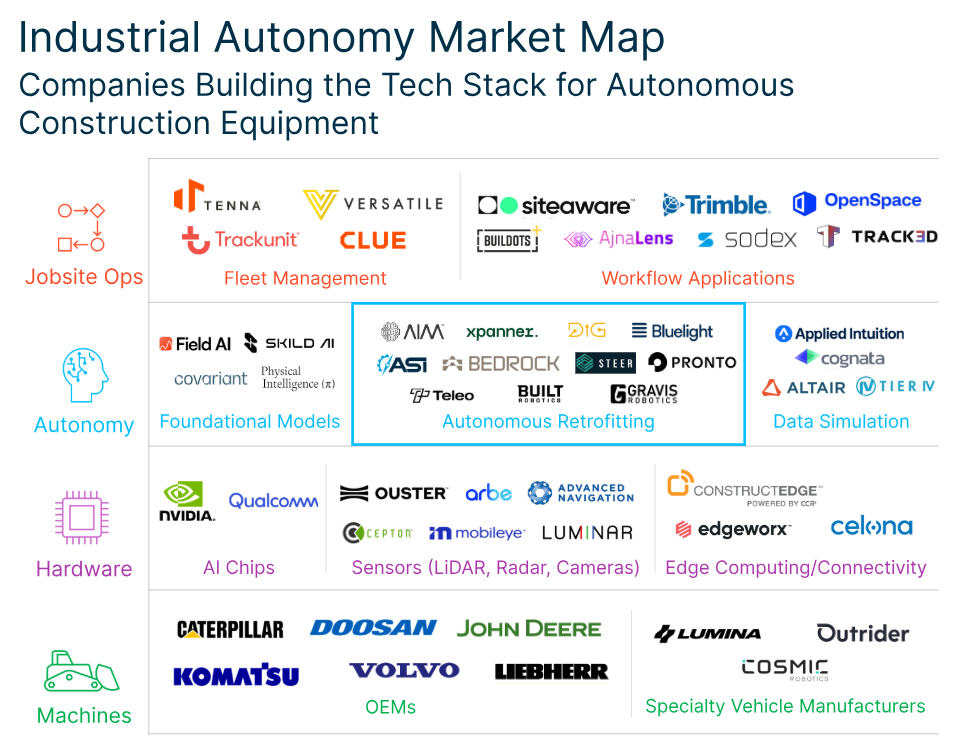
Together, these advances are moving intelligence into the equipment itself. The cloud still plays a critical role, but increasingly as a training and fleet-learning layer rather than the brain of the system. Sensors, edge compute and control software now form a tightly integrated autonomy stack, and the companies that master that integration gain a durable advantage.
4. The right tools for the job: Domain knowledge is key in industrial AI
Industrial autonomy is not plug and play software. Deployments require deep, sector-specific knowledge and close integration with how work actually gets done across different interconnected parties.
At CES in January, Caterpillar announced a new lineup of autonomous heavy equipment, including excavators, bulldozers, loaders and haulers, reflecting a broader trend of incumbents embedding autonomy directly into their machines. Caterpillar also demonstrated an in-cab AI-assistant to coach and guide human operators and technicians. Embedding such AI makes a full-conversion to autonomy much easier.
Innovators are taking notice. Unlike enterprise SaaS, which often seeks to disrupt and replace incumbents, industrial AI companies are partnering with original equipment manufacturers (OEM). The heavy equipment industry relies on deeply embedded, often regionally located dealer and distributor networks that serve as the primary interface for customers for everything from the parts and maintenance to digital aftermarket products.
"Far more important than technical capabilities, innovators must deeply understand the incredibly complex nature of the heavy equipment go-to-market value chain and range of critical constituents within it," Findley of Ironspring Ventures said. "From the OEM, to the equipment dealer/distributor, to the end customer actually breaking ground, all of those parties must be carefully coordinated to deploy autonomy at scale."
Partnerships with tech providers are proving increasingly common in this space. AIM tends to white label much of their software and work directly with equipment manufacturers and owners. This process involves deploying an AIM team to a client’s site for several weeks to train operators and retrofit machinery.
"We're a Switzerland of the heavy machinery market. We are partnering across colors of iron, geographical areas, and range from retrofit to OEM integrated solutions," Sadilek said. "We are only beginning to announce the full gamut of AI fleet deployments and partnerships we have forged over the last four years of commercial operations around the world."
Successful deployments also require integration with existing workflows — surveying, dispatch, fleet management and jobsite coordination systems that already underpin industrial operations. In this environment, domain-specific platforms consistently outperform general-purpose tools. Autonomy becomes most valuable when it fits into how equipment is scheduled, monitored and maintained.





 Article