Read more about our corporate brand here.

Search
Treasury Management

AI for treasury management: Why maturity matters for ROI

Rina L. Arline, Isa Abney
October 23, 2026

Key takeaways

  • Strengthen AI in treasury management with reliable data, integrated systems and real-time cash visibility to improve forecasting.
  • Use treasury automation and API integration to streamline reconciliation, reporting and exception handling while reducing manual work.
  • Combine AI in corporate treasury with human expertise to strengthen decisions across cash optimization and liquidity strategies.

Why mature treasury operations matter for AI value

As companies increase in treasury complexity by adding more transaction volume, legal entities, systems and banking relationships, some of their processes can be slow to keep up. Finance leaders are increasingly trying to close that gap using AI for treasury management, but is the treasury function mature enough to act on those insights?

Three themes are emerging from our analysis and conversations with clients across industries: AI value depends on treasury maturity, systems integration turns data into action, and liquidity management preserves a company’s ability to pivot and respond.

Market insights and client perspectives on AI

To contribute on-the-ground experiences to our analysis, we invited two First Citizens Bank clients to share their perspectives and recent examples from their work. Jerry Caruso is VP, Global Controller at Bitsight, a global leader in cyber risk intelligence. Ran Rabinowitch is Head of Finance for the device business at Wyze, an innovator in consumer electronics.

The promise of AI for treasury management is clear. It enables teams to better understand and act on patterns, as well as uncover issues that require deeper attention. For many companies, AI has become a strategic imperative. Our "State of the VC-Backed CFO" report noted that among VC-backed companies, "62% ranked AI adoption as a top-two issue, up from 49% from last year." The pattern is similar across other industry verticals. KPMG's 2026 Global AI in Finance study looked at enterprises across 13 industries (such as manufacturing, healthcare and energy) and found that 75% are using AI for finance functions.

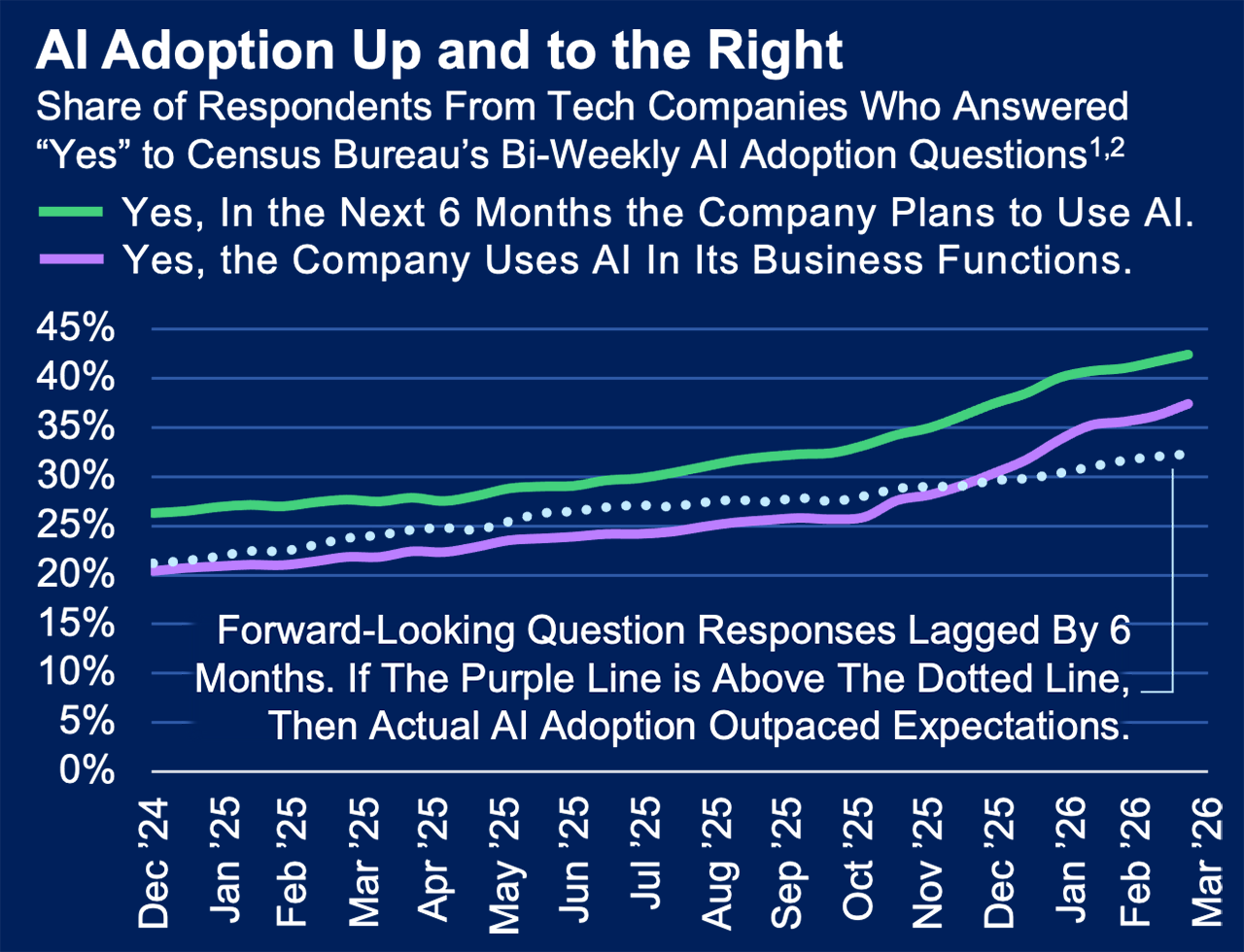
Chart showing rising AI adoption over time Our research indicates that AI adoption is outpacing expectations. Source: State of Enterprise Software 2026, First Citizens Bank Notes: 1) Tech companies defined as the information sector as determined by the Census Bureau NAICS classifications. 2) Survey questions include “Between MMM DD – MMM DD, did this business use Artificial Intelligence (AI) in any of its business functions?” and “During the next six months, do you think this business will be using Artificial Intelligence (AI) in any of its business functions?”

The finance tech stack is evolving beyond systems that primarily record and report information into systems that enable teams to initiate actions. And this becomes more crucial as a company grows. It also raises new questions about controls, authorization, auditability and the role of human oversight as AI gets deployed.

5 capabilities to make treasury AI-ready

In practice, capturing value from AI comes down to a set of core capabilities for finance teams.

  1. Visibility – to maintain a clear, real-time view of cash position. An integrated view of cash management enables companies to track deposits, liquidity, loans, credit and payables in one place. This represents the ground truth to support decisions and take action.
  2. Connectivity – to seamlessly move money and data across banks and internal systems. Treasury API integration and other connectors help teams automate processes to reduce manual work and improve data quality.
  3. Control – to govern finance operations, risk management and compliance. Managing treasury at scale requires controlled oversight over user access, approvals, exceptions and more.
  4. Optimization – to better manage capital, liquidity and payments. It may include improving how a company structures systems, processes and data flows to manage and deploy operating and idle cash.
  5. Intelligence – to unlock business value from data. With unified financial data, organizations gain insights to make more timely, informed decisions for liquidity planning, forecasting and risk.

1. Visibility How growth makes cash visibility harder

As a company grows, keeping a clear view of cash gets harder. Payment volumes increase, more accounts must be monitored, and cash balances may become larger and perhaps more volatile. That puts pressure on treasury teams to understand where cash is and what they may need next. Manual reporting and reconciliation processes often spring up in response, which have the long-term impact of undermining visibility. Successful teams focus on integrated systems and centralized data to see cash across the business and make better liquidity decisions.

2. Connectivity Connectivity turns treasury intelligence into action

AI can surface useful insights, but acting on them is harder when information and workflows are fragmented.

Our internal First Citizens Bank analysis shows that API adoption increases among clients with greater treasury and operating complexity. API usage reaches 14.3% among middle-market companies and nearly 21% among larger companies operating globally. The pattern suggests that API use is associated with treasury maturity and that integrated connectivity becomes increasingly important as transaction volumes, systems, and governance requirements grow.

Automating workflows

Companies use AI to automate routine tasks and treasury workflows such as reconciling transactions and invoices, identifying exceptions and routing them to the right person. KPMG's Digitization in Accounting study found that among businesses using AI to automate accounting work, 70% reported improved process quality and 37% noted significant time savings after implementation.

Connecting a client's bank, ERP and treasury systems through APIs and other integrations can improve the quality, accessibility and consistency of data AI can use. Connectivity in turn supports automation across finance functions including receivables, payables, reporting and reconciliation.

Ran Rabinowitch described how his team is building internal solutions to reduce manual work. After the monthly close, there used to be a series of tasks to generate reports.

"Now, clicking the close button can send an agent to pull and update tables using predefined queries, save them to a predefined template, and then generate the report."

The impact is significant.

"What used to take a couple of weeks to get everything out can now take an hour."

Ran Rabinowitch

Wyze, First Citizens Bank client

3. Control AI changes how treasury controls need to work

As work is automated, controls around access, approvals, fraud and exception handling become more important. In a 2026 Deloitte study, 59% of CFOs said their biggest AI governance challenge is balancing adoption with risk.

Jerry Caruso offered a concrete example of the controls that become important. Data integration has to be managed with appropriate permissions.

"You want to make sure that you've got some level of organizational confidence that, as the Controller, I can upload data that no one else can see unless they have appropriate permissions."

Jerry Caruso

Bitsight, First Citizens Bank client

Treasury controls must also define when a human review is needed. Decisions involving payment authority, account structures, policy changes or material exceptions are good examples.

"I wouldn't put an AI on approving these exceptions right now … I don't think AI has a good understanding of the business yet."

Ran Rabinowitch

Wyze, First Citizens Bank client

4. Optimization Treasury optimization starts with liquidity management

Managing liquidity and capital well can be critical to sustaining growth. The journey to profitability takes time, and financial execution has to demonstrate the discipline to support it. Among firms earning $10 million to $25 million in revenue, our latest CFO report found that 74% are still in the red, and 20% have a 1-year gap in the runway needed to reach profitability. Bridging that gap, or avoiding it entirely, can depend on how effectively a company manages cash and deploys capital.

As companies grow, finance leaders may need to rethink where cash sits and how efficiently money moves.

"Helping us determine what the minimum cash target should be, what portion of cash we should keep in the operational account versus what cash we can actually utilize for better yields, could be beneficial and could drive real value for the company."

Ran Rabinowitch

Wyze, First Citizens Bank client

However, analytics and liquidity planning are challenging use cases for AI in treasury management. Cash flow patterns fluctuate shaped by stages of growth, business models, supply chain strategies, expansion goals and other factors. We continue to think this is an area that benefits from human judgement and collaboration.

5. Intelligence Turning treasury data into business value

Improving AI cash flow forecasting and analysis is possible if the underlying financial data is reliable. But companies are still struggling with ROI.

63% of large-enterprise finance leaders are using AI, but only 21% are finding measurable ROI.

Finance Trends 2026 report

Deloitte

AI ROI may show up as greater analytical depth, faster cycles and more work completed with the same team.

"AI gives me hope that I can manage the volume that's there at a deeper level."

Jerry Caruso

Bitsight, First Citizens Bank client

Traditional productivity metrics may not fully capture all of these benefits.

CFOs may need a tiered ROI framework: lightweight evidence for experimentation, but increasingly rigorous business cases as AI spending or deployment scales. Ran described a more explicit AI investment model in which greater spending requires greater proof.

"Depending how much you want to spend, there's the level of ROI evidence that is required."

Ran Rabinowitch

Wyze, First Citizens Bank client

In our recent CFO report, we found that even among more mature companies, 63% still rely heavily on spreadsheets for budget planning. This is consistent with findings from the Association of Financial Professionals report that notes that across industries, 96% of FP&A professionals use spreadsheets as a planning tool at least weekly. Spreadsheets often make up for gaps in data flows and integration.

When data is better curated and fed by real-time access, AI and treasury analytics can help treasury teams see patterns earlier, improve forecasts and make more informed decisions on liquidity, capital and risk. This also better positions them to respond to the increasing urgency to implement AI solutions.

Balancing AI with human expertise

Using AI responsibly includes a clear awareness that accountability remains with finance leaders.

"There are lots of low-hanging fruit … but there are certain complex areas that … require company-level expertise."

Jerry Caruso

Bitsight, First Citizens Bank client

Where does human experience matter most? It concentrates in critical decisions such as setting policies for liquidity, investments and risk. Expertise is also essential in high-stakes moments, like resolving material exceptions related to an enterprise customer, dealing with a service disruption, or managing a data breach crisis.

"The future of banking will be shaped by how effectively we combine AI-enabled intelligence with trusted data, strong governance and human expertise. The opportunity goes beyond making today's work faster. It is about reimagining how work gets done, with AI transforming processes end to end while people provide judgment and deliver better outcomes for our clients."

Ash Kaduskar

Head of AI and Advanced Analytics, First Citizens Bank

Combining human judgment and AI intelligence brings together the best of both worlds.

AI in treasury—ROI depends on more than tech

AI adoption in finance is accelerating, but the economic results remain uneven and hard to track. That gap is important for treasury leaders who are usually asked to turn vast amounts of data into precise forecasts and automated recommendations for better liquidity decisions. The tech may be new, but getting value still depends on operational fundamentals.

Building tangible value through workflow automation, better forecasting and working capital management requires a strong foundation. To turn AI intelligence into informed action, companies need mature, scalable treasury operations that combine integrated solutions, reliable data and strategic expertise.

Combining treasury automation and AI intelligence with expert human judgment helps you capture more ROI as complexity increases. AI can identify and propose a response, but leaders need to decide whether and how to act. This combination provides greater agility to sustain growth, solve problems quickly and act on opportunities amid challenging markets.

Frequently asked questions

AI in treasury management can help finance teams improve key finance functions. This includes strengthening cash forecasting, automating workflows to reduce manual work, identifying exceptions faster and reducing risk. AI value increases when it can work with reliable and consistent data across integrated financial systems.

AI has greater opportunity to deliver value when companies have mature treasury operations with integrated systems, disciplined processes and strong controls. Treasury API integration can help connect information across banks and internal systems, and automating finance tasks can save time to help improve productivity.

Treasury automation can reduce manual work in routine tasks such as reconciliation and invoice processing, reporting, exception handling and data sync to ERP or accounting software. It helps finance teams improve efficiency as transaction volumes and complexity increase.

No. Responsible AI in corporate treasury augments finance teams with automation and insights, but decisions still rely on the expertise of finance executives. AI intelligence helps improve analysis, forecasting and decision speed, but CFOs, controllers and other finance leaders are still accountable to make critical decisions.

Automation can reduce treasury operational risk by reducing manual work in processes such as reconciliation, reporting and exception handling. Integrated workflows can improve data quality, route exceptions to the right people, and support stronger controls around access, approvals and human review.

Read next

Explore these related articles to help you stay on top of the latest data, insights and developments in business growth and treasury management.

AI for treasury management: Why maturity matters for ROI Treasury Management
Read Article Article

AI for treasury management: Why maturity matters for ROI

Oct 23, 2026

Rina Arline, Isa Abney

Strategic cash flow management - a guide for growing businesses Treasury Management
Read Article Article

Strategic cash flow management - a guide for growing businesses

Oct 30, 2025

Isa Abney, Oliver Grummitt

Powering scalability with integrated banking for startups Treasury Management
Read Article Article

Powering scalability with integrated banking for startups

Jul 23, 2025

Brian Taylor, Isa Abney

More about the authors

Rina L. Arline

Rina L. Arline

Managing Director

Isa Abney

Isa Abney

Director, Payments Business Implementation


The views expressed in this article are solely those of the author and do not necessarily reflect the views of First Citizens Innovation Banking.

This material, including without limitation the statistical information herein, is provided for informational purposes only. This information should not be viewed as tax, investment, legal or other advice nor is it to be relied on in making an investment or other decision. You should obtain relevant and specific professional advice before making any investment decision. Nothing relating to the material should be construed as a solicitation, offer or recommendation to acquire or dispose of any investment or to engage in any other transaction. 

Links to third-party websites may have a privacy policy different from First Citizens Bank and may provide less security than this website. First Citizens Bank and its affiliates are not responsible for the products, services, and content on any third-party website.

Third parties mentioned are not affiliated with First-Citizens Bank & Trust Company.

Banking, lending and trust products or services are offered by First-Citizens Bank & Trust Company. Accounts are subject to credit approval. Restrictions and limitations may apply.

Back to top
You are now leaving First Citizens Innovation Banking

You will be directed to a different website or mobile app that has its own terms of use, visitor agreement, security and privacy policies. First Citizens Innovation Banking is not responsible for (and does not provide) any products, services or content at the third party site or app, except for the products and services that carry the First Citizens Innovation Banking name.