


Jump To
Tech
The Future of Climate Tech 2024
Jordan Kanis, Eli Oftedal, Josh Pherigo
Key takeaways
The risks of climate change are becoming increasingly clear, and the appetite for technological solutions continues to grow. As a result, the innovators leading the way to a net-zero future have the wind at their backs even amid a decline in overall venture capital investment. Our latest report explores the opportunities available in this optimistic but complex landscape. Here are three takeaways:
$11B
In US VC fundraising closed in the last 4 quarters
Climate tech VC fundraising has held up well, settling at a historically high level.
14%
Decline in deal activity since 2021
Compared to the 24% decline in overall US VC deal activity, climate tech remains resilient.
60%
Of climate tech companies with less than 12 months of cash runway
Cash continued to fall for climate tech startups in 2023.
Read the full Future of Climate Tech Report
Get the context behind the emerging trends in cleantech and sustainability-focused venture capital.
The data
The latest edition combines climate data on emissions, SVB proprietary data and market analysis to paint a detailed picture of the near-term capital challenges and long-term tailwinds defining climate tech.
CLIMATE TECH VC INVESTMENT
Investment outpaces VC ecosystem
While overall US VC investment has seen the most substantial correction since the dot-com bubble, VC deal activity in climate has remained relatively steady.
This resilience is supported by government incentives, increasing awareness of climate risk and long-term technology trends that are reducing the cost of renewable energy.
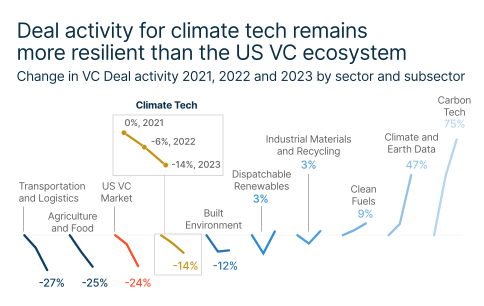 Note: Enabling technologies are not explicitly climate tech, but play a key role in enabling climate tech, such as certain edge computing, which could enable enhanced demand response. Sources: SVB proprietary taxonomy, Cleantech Group, PitchBook Data, Inc. and SVB analysis.
CLIMATE TECH CASH BALANCES
Climate tech companies see declines in cash runway
60% of climate tech companies have less than 12 months of cash runway. That compares to 53% of all tech companies.
Because climate tech companies tend to address more difficult technological challenges, they tend to be more capital-intensive than their peers. The resulting decline in runway may create a favorable funding environment for investors in 2024.
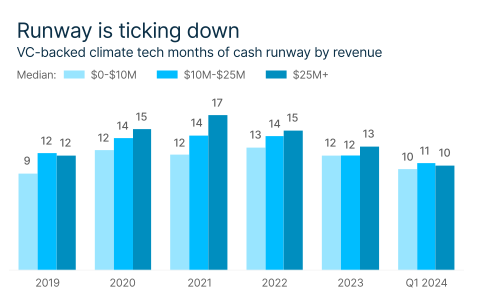 Sources: SVB proprietary data and taxonomy, Cleantech Group, PitchBook Data, Inc. and SVB analysis.
Download The Future of Climate Tech Report
Explore SVB's full report examining the trends and innovations in cleantech and sustainability.
More about the authors



Explore other First Citizens Innovation Banking Reports
 Reports
 Report
The Future of Healthtech 2026
Nov 09, 2026
Megan Scheffel, Adam Tweedy, Dennis He, Matt Donne, Alex Lennox-Miller, Urbashee Paul, Josh Pherigo
 Reports
Report
The Future of Fintech 2026
Oct 13, 2026
Nick Christian, Brian Foley, Julie Wagne, Sophie McNaught, Josh Pherigo, Eli Oftedal, Andrew Pardo
 Reports
Report
The Future of Climate Tech
Apr 15, 2026
Jordan Kanis, Eli Oftedal, Josh Pherigo, Andrew Pardo