Read more about our corporate brand here.

Search
Corporate Card

Rethinking commercial card program management during major organizational change

Lisa Treshnell
October 19, 2026

Key takeaways

  • Reassess commercial card program management after major organizational change to ensure controls, policies and workflows fit how the business now operates.
  • Maintain control and manage spend with flexible processes during M&A and CFO transitions.
  • Optimize your corporate card program after a merger to reduce manual work, strengthen compliance and scale more efficiently.

Why big change may force a shift in your commercial card program management

Organizational change can stress-test your corporate card program management. Change can come in many forms that affect how you operate and manage spending. For example, innovation economy companies may stack up technological capabilities through mergers & acquisitions (M&A). Or, as the business matures, you may take on a more seasoned CFO or reorg the finance team across entities or lines of business.

A corporate card program that worked well before a major transition may no longer fit your company. Reporting lines and approvers change. Cost centers and budgets shift. Employees may move into different roles or new teams come on board. How will your current processes, corporate card controls and policies work in the new organization?

Here I'll highlight common challenges that come with big changes, and how to maintain or improve spend management after the transition. Also, as I often recommend to clients, you can use this event as an impetus for commercial card program optimization.

Where organizational change can expose gaps in your corporate card program

Your commercial card program should reflect how your company operates. But when the organization undergoes major change, existing processes and assumptions for the program can quickly become outdated.

Suppose you're still getting by with manual expense reporting and reconciliation. The added workforce of an acquisition may require a burst of new spending that turns into a flood of excess paperwork for your finance team. Forty-four percent of CFOs say that increased workload for existing staff is their top concern, according to Deloitte's 2025 CFO Signals study. And yet, you may want to avoid hiring more finance staff. So, it's likely time to replace manual work with automated expense reporting.

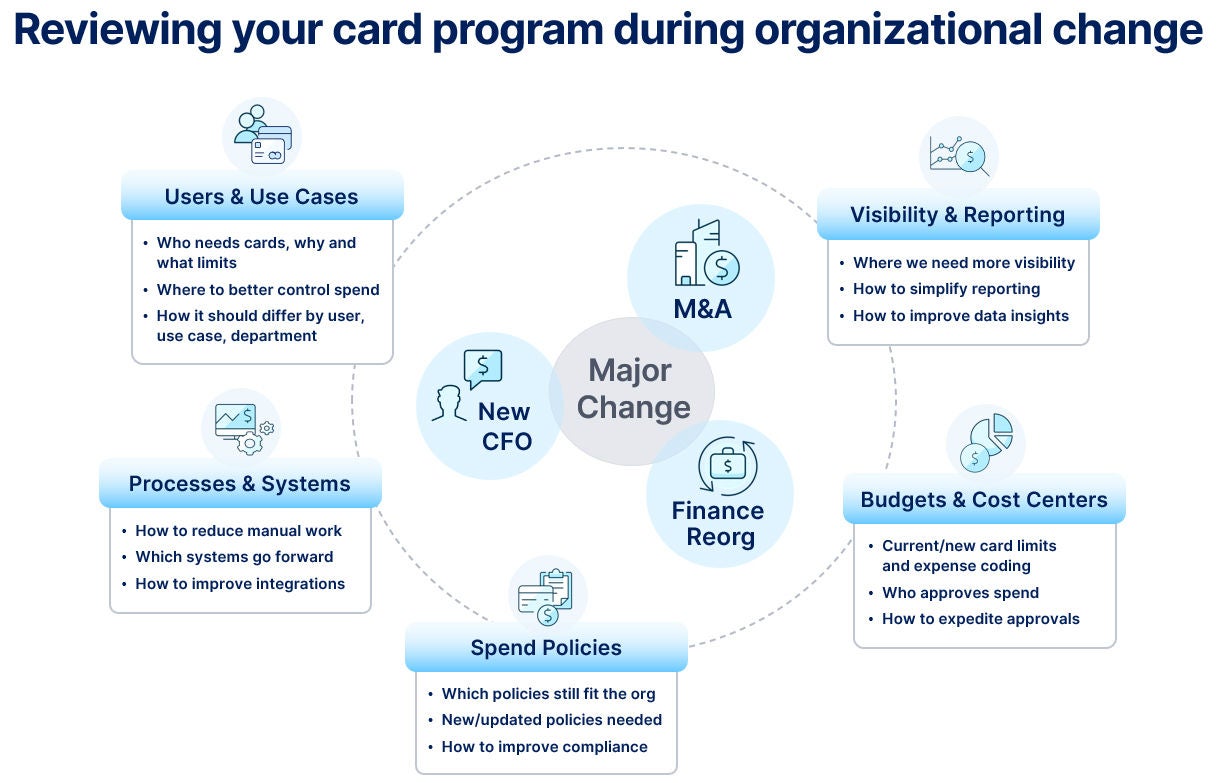
An acquisition, new CFO or finance restructuring can also change who owns budgets, which employees need corporate cards and how expenses are coded. And less formal card spend policies that worked before may not support a new, more complex or disciplined way of working.

M&A can change the way a company manages spend almost overnight. Bringing two organizations together means navigating different card policies, approval structures, spending limits and accounting practices. Finance teams need to decide what goes forward, who approves, and how to align controls with new roles and cost centers.

Be proactive and use the transition to your advantage. Look at where your corporate card program management needs to evolve to fit the new organization, rather than scrambling to fix problems down the road.

Maintaining spend control during M&A and finance transitions

Organizational change can be disruptive, but strategic commercial card program management can help you keep teams and projects moving forward. Through M&A, employees may need to purchase new equipment, supplies and SaaS subscriptions. A division re-org might mean issuing new corporate cards and retiring others. And a new CFO might look to cut costs and boost efficiency by consolidating vendors.

But first, you need to maintain control while the organization is in flux. There's often a period when roles, reporting lines and policies are still being sorted out. That may mean implementing temporary processes to effectively manage the transition. Then when the dust settles, you can look at long-term corporate card program optimization. For instance, set up temporary approval processes, monitor card activity more closely for exceptions and unusual spend, and provide clear communications so employees know what to do while policies are changing.

The key is for the finance team to keep enough control and visibility over card spend to manage risk, without creating bottlenecks that slow down the business.

Card program review during organizational change

Using the transition to optimize commercial card program management

For venture-backed companies, a major organizational change is a pivotal opportunity to build more value into your card program in terms of cost controls, efficiencies and corporate card cash rebates. So don't just migrate yesterday's program into tomorrow's company—use the change to rethink it.

As an example, re-assess which users and roles need a physical card, and where virtual cards make more sense (because you can limit budgets, categories, timeframe, etc.). Also consider how to take full advantage of automated spend management. When the platform is integrated with your commercial card, you can:

  • Automate expense reporting and reconciliation. Employees save time with a mobile app that automates receipt capture and expense coding, so they can submit expenses in a few taps. It gives finance a real-time view into spending, with more complete and accurate coding to reduce corporate card reconciliation work. You can also use accounting integrations to automatically stream expense data to your finance software or ERP.
  • Increase spend policy compliance. Post-transition, it can get harder to ensure compliant spend. The spend management platform lets you create and auto-enforce policies, so employees see transaction alerts in the moment to guide the desired behaviors.
  • Make better, data-driven decisions. An added benefit of using virtual cards and automation in finance is that you can capture cleaner, richer transaction data for actionable insights. Analytics can help you spot spending patterns, cost trends and unusual activity you might otherwise miss.

For a fast-growth company, the goal is to make the corporate card program easier to manage and scale as headcount, entities and spending requirements continue to change.

When your business navigates a major change, your card program management will evolve as well. Choosing a scalable solution that can adapt to new teams, controls and policies makes it easier to keep moving forward without starting over. Learn more about SVB commercial cards.

Frequently asked questions

During M&A, review cardholders, approval routing, spending limits and expense policies to make sure they still fit the combined organization. While decisions are still in flux, you can implement temporary controls and approval processes to help maintain oversight, without slowing down the business.

A new CFO may want to assess which employees have corporate cards, how budgets are handled, how spend is approved and how reporting is managed. It's also important to identify where manual processes create delays and inefficiencies (that might be solved with automation).

Amid organizational changes that may affect corporate card spending, maintain clear approval paths, closely monitor exceptions and unusual activity, and clearly communicate temporary policies to employees. The goal is to preserve spend visibility and control while the new organization takes shape.

Major organizational change (like M&A, finance restructuring or rapid growth) can be a useful trigger for commercial card program optimization. It's an ideal time to reassess card controls, spend policies and reporting processes to see if they fit how the business will operate going forward.

Read next

Explore these related articles to help you stay on top of the latest data, insights and developments in commercial and corporate card.

Rethinking commercial card program management during major organizational change Corporate Card
Read Article Article

Rethinking commercial card program management during major organizational change

Oct 19, 2026

Lisa Treshnell

Scalable spend management – What to do when growth breaks your expense processes Corporate Card
Read Article Article

Scalable spend management – What to do when growth breaks your expense processes

Jun 26, 2026

Lisa Treshnell

Vendor consolidation checklist: 7 signs your startup should consolidate vendor spend Corporate Card
Read Article Article

Vendor consolidation checklist: 7 signs your startup should consolidate vendor spend

Jun 10, 2026

Angela Sellers

More about the authors

Lisa Treshnell

Lisa Treshnell

Global Payments Solutions Advisor


This information is provided for educational purposes only and should not be relied on or interpreted as accounting, financial planning, investment, legal or tax advice. First Citizens Bank (or its affiliates) neither endorses nor guarantees this information, and encourages you to consult a professional for advice applicable to your specific situation. Third parties mentioned are not affiliated with First-Citizens Bank & Trust Company.

Links to third-party websites may have a privacy policy different from First Citizens Bank and may provide less security than this website. First Citizens Bank and its affiliates are not responsible for the products, services, and content on any third-party website.

Banking and lending products or services are offered by First Citizens Bank. Accounts are subject to credit approval. Restrictions and limitations may apply.

Back to top
You are now leaving First Citizens Innovation Banking

You will be directed to a different website or mobile app that has its own terms of use, visitor agreement, security and privacy policies. First Citizens Innovation Banking is not responsible for (and does not provide) any products, services or content at the third party site or app, except for the products and services that carry the First Citizens Innovation Banking name.