


Jump To
Reports
State of the Markets Report H1 2026
Marc Cadieux, Mark Gallagher, Eli Oftedal, Josh Pherigo, Jake Ledbetter, CFA, Andrew Pardo
Key takeaways
Our State of the Markets report distills venture capital fundraising, investment and exit dynamics across the venture landscape using SVB proprietary insights. Every 6 months, we pair our proprietary data with investor conversations and independent market analysis to equip the innovation economy with timely, practical insights.
$340B
Invested in US VC-backed companies in 2025
2025 marked the second-strongest year on record for US VC, driven primarily by mega deals.
$4.4T
Of value is locked in US private unicorns
Half of US VC-backed tech unicorns exceed $800M in revenue—easily clearing the $400M IPO benchmark.
5
AI companies outvalue all dot-com era IPOs
They also captured one-third of US tech VC funding in 2025.
The data
A near-record $340B in investment and the best exit environment since 2021 signal a venture rebound, though heavily concentrated in AI mega deals. Barring major disruptions, we anticipate momentum to build in 2026 with moderate deal growth due to an AI platform shift and growing investor confidence.
Mega Deals
Is a $1B venture capital deal really venture?
Last year, 24 companies received billion-dollar VC deals, and mega-deals of $500M or more accounted for nearly half of all 2025 deal activity. Deals of this scale may be venture in name but defy the risk and return profiles of traditional early-stage venture.
Valuations and capital that were once reserved for the public markets are now possible, or even expected for the top companies.
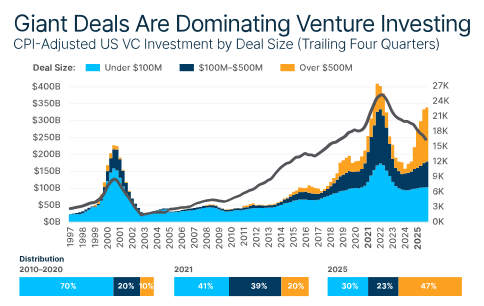 Notes: VC investment is adjusted to 2025 dollars, including deal sizes. The VC totals from 1995-2004 are sourced from PwC’s MoneyTree report, and VC totals from 2005-present come from PitchBook Data, Inc. PitchBook’s deal size distributions were applied PwC MoneyTree data. Source: PwC MoneyTree, PitchBook Data, Inc. and SVB analysis.
Future Funding
Slower growth, longer road to raise
VC-backed companies are facing compounding challenges—the revenue required to fundraise is higher today, yet revenue growth rates have slowed substantially.
These higher benchmarks to raise are contributing to far lower graduation rates and more companies turning to extension rounds to meet runway shortfalls.
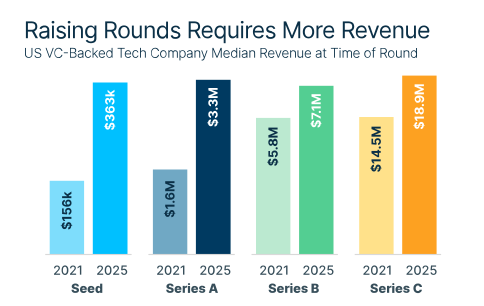 Notes: Trailing 4 quarters; annual total revenue (recurring and one time sales) at time of raise for companies that raised a given series in 2025. Source: PitchBook Data, Inc. and SVB proprietary data and analysis.
AI Hype Cycle
AI investment reaches dot-com era levels
Venture dollars in AI deals skew toward horizontal platforms. These core AI companies that include language models account for one-quarter of AI startups but receive half the investment.
The ecosystem hinges on the top AI companies: one-third of the $560B invested in AI has gone to five companies.
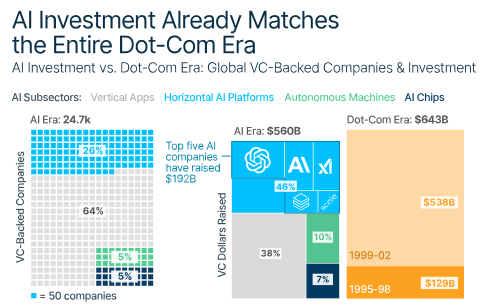 Notes: 1) Deals converted to 2025 dollars. VC values for years 1995-2004 were taken from PwC Moneytree, while VC totals for 2005-2025 came from PitchBook data. The distribution of capital by deal size came from analysis of PitchBook. Those distributions were applied to MoneyTree totals. Source: Domain Name Stat, PwC MoneyTree, PitchBook Data, Inc. and SVB analysis.
Explore the full State of the Markets report
Get insights on the emerging trends shaping the innovation economy.
SOTM H1 2026 FAQs
SVB's State of the Markets report is a bi-annual outlook on the innovation economy that distills venture capital fundraising, investment and exit dynamics using SVB’s proprietary data and 40+ years of insight from partnering with innovative startups. Each edition pairs our data with investor conversations and independent market analysis to deliver timely, practical insights.
This report is designed for key decision-makers within the innovation economy, including:
- Founders: To understand the current market landscape, identify opportunities and benchmark their performance.
- Investors: To gain insights into market trends, identify promising sectors and understand the exit landscape.
- Finance Leaders: To make strategic decisions based on data-driven analysis of the market.
The State of the Markets report is published every six months to provide the most current and relevant insights. This H1 2026 State of the Markets report synthesizes full-year 2025 activity with a practical outlook for the first half of 2026.
The overall AI sector is attracting a massive amount of US VC investment—$560 billion since 2022. That's equal to total deployment during the dot-com era. The top five highest valued AI companies alone have attracted a third of this funding, and their values are currently three times higher than the inflation-adjusted value of all US VC-backed internet IPOs from 1995 to 2002.
Nearly $350 billion flowed into US venture capital deals in 2025, however, US VC fundraising fell to a 7-year low. AI's continued surge and the uptick in exits in 2025 seems to have lined the coffers of growth funds, but not most VC funds. Heading into 2026, we expect fundraising to increase this year as some capital starts to cycle back to limited partners, or LPs, and big funds that raised in 2022 to 2023 come back to market. Sixty-three percent of capital raised by $1 billion funds in 2022 has been deployed.
2025 was the best year for US VC-backed tech IPOs since 2021. Yet for many in the industry, it didn't feel all that positive. That's because the profile of today's IPO—and public market perception—is markedly different than before. Only half of US VC-backed tech companies in 2025 were above their last private valuation, and less than a third above their initial IPO market value. Such lukewarm reception from public markets may push some startups to wait before pulling the IPO lever for liquidity.
AI spending is driving a significant portion of US economic growth. Private investment in the Bureau of Economic Analysis, or BEA, buckets that capture AI—hardware, R&D, software and data centers—is under 4% of US gross domestic product, or GDP, yet these categories contributed 10% to 30% of quarterly GDP growth in 2025. In Q1, they offset what would have been a deep economic contraction, a Fed study showed.
The volume of US VC-backed M&A deals in 2025 ticked up to the highest total since 2022—1,050 deals—growing 11% year-over-year. Disclosed deals totaled $128 billion in 2025, the most in 4 years. However, signs suggest that the majority of acquisitions aren't money makers for investors. Only 12% of 2025 deals have known sales prices greater than the capital these companies raised.
More VC-backed companies are buying other companies. These deals tend to be smaller—the median capital raised for companies acquired by other startups was 33% less than deals with other buyers. That's slightly lower than the prior 2 years. One reason VC-backed buying is picking up may be that investors are finding value in all-stock deals.
There is no single benchmark revenue that a startup must have in order to raise a given series funding round. The middle 50% of companies will raise a Series A with between $1 million and $6.5 million in revenue. Some companies will raise Series A rounds with no revenue, and others will raise with tens of millions.
Companies will typically grow revenue between 8 and 12 times between seed and Series A. This massive leap contributes to the lower graduation rates between seed and Series A compared to later stages.
Ultimately, defining the exact revenue a company needs to reach the next round depends on the company and sector, given there's a high degree of variance between companies and across sectors.
The report provides practical insights to help you:
- Understand where the market is concentrated.
- Benchmark your company's performance against the market.
- Identify which liquidity paths—IPOs and M&A—are opening or staying constrained.
- Make informed, real-time decisions based on proprietary data and insights.
More about the authors






Explore other reports
 Reports
 Report
The Future of Climate Tech
Apr 15, 2026
Jordan Kanis, Eli Oftedal, Josh Pherigo, Andrew Pardo
 Reports
Report
Reports
Report
50 BY 2050
Jordan Kanis, Joshua Posamentier, Eliza Cushman, Marianne Wu, Hilla Watkins
 Reports
Report
Reports
Report
The State of Corporate Venture Capital 2026
Mark Gallagher, Patrick Eggen, Mikey Kalis, Emma Eschweiler, Abbie Wolf, Anjalika Komatireddy, Eli Oftedal, Jake Ledbetter