


Jump To
Reports
The State of CVC 2025
Mark Gallagher, Patrick Eggen, Mikey Kalis, Emma Eschweiler, Abbie Wolf, Anjalika Komatireddy, Eli Oftedal, Jake Ledbetter, CFA
Key takeaways
CVCs are evolving their strategies in 2025. The pace of investment is more deliberate, as CVCs pursue fewer, more targeted deals. AI investment continues to grow as a pillar of corporate innovation strategy. Efficiency and liquidity challenges are also prompting funds to seek greater independence from their corporate parents.
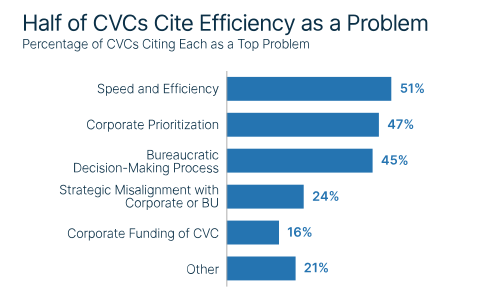
51%
Of CVCs cite speed and efficiency as persistent challenges
Corporate prioritization and bureaucratic decision-making are also common roadblocks.
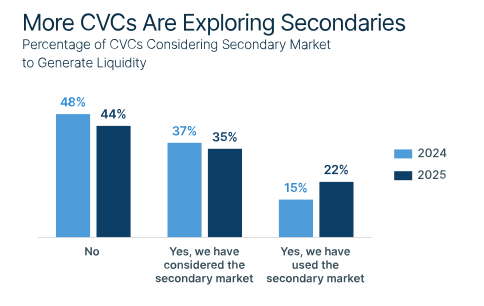
22%
Of CVCs have used the secondary market to generate liquidity
That’s up 7 percentage points from last year.
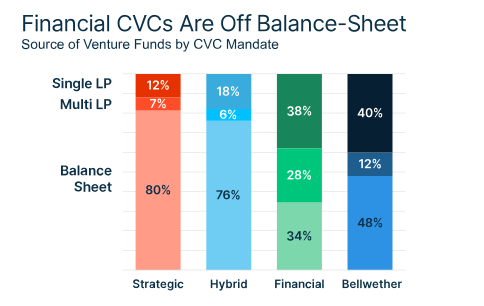
2 in 3
Financial CVCs are off balance sheet
Among strategic funds, the ratio is 1 in 5.
The data
The 2025 State of CVC report, co-authored by Silicon Valley Bank and Counterpart Ventures, draws from a survey of prominent active global corporate venture capital funds to explore how they’re adapting their strategies, prioritizing technologies like AI and navigating corporate dependencies.
AGILITY
CVCs’ greatest challenge is inefficiency
The top three problems facing funds are speed and efficiency, corporate prioritization and bureaucratic decision-making.
Each creates internal friction that slows execution in an ecosystem that rewards speed.
 Notes: Respondents could choose multiple options. Source: CVC survey and SVB analysis.
LIQUIDITY
Secondaries are entering the playbook
The use of secondaries has grown among CVCs, jumping from 15% in 2024 to 22% in 2025.
Under pressure to support follow-ons in a constrained funding environment, funds are embracing new liquidity tools.
 Source: CVC survey and SVB analysis.
FUNDING STRUCTURE
Most financial CVCs aren’t on balance sheet
Financial CVCs are more likely than their strategic counterparts to be off balance sheet and far more likely to have a multi-LP structure.
Off balance sheet models offer greater compensation and independence. In an era of less scrutiny on corporate spending, more funds are considering adopting them.
 Source: CVC survey and SVB analysis. Note: Other category not shown that represents less than 1% of total responses. For this reason and as a result of rounding, totals may not equal 100%.
Download the full report
Don’t miss these insights into the dynamics of the CVC ecosystem.
More about the authors








Explore other reports
 Reports
 Report
The Future of Climate Tech
Apr 15, 2026
Jordan Kanis, Eli Oftedal, Josh Pherigo, Andrew Pardo
 Reports
Report
Reports
Report
50 BY 2050
Jordan Kanis, Joshua Posamentier, Eliza Cushman, Marianne Wu, Hilla Watkins
 Reports
Report
Reports
Report
The State of Corporate Venture Capital 2026
Mark Gallagher, Patrick Eggen, Mikey Kalis, Emma Eschweiler, Abbie Wolf, Anjalika Komatireddy, Eli Oftedal, Jake Ledbetter