


Jump To
Reports
Physical AI and the Future of Robotics
2026
Key takeaways
In SVB’s first-of-its-kind market insights report on hardware and physical AI, we track the surge of venture capital into US hardware and the growing shift by global VCs toward physical technologies. We examine how advances in AI are enabling robots to operate in unfamiliar environments, how supply chain and trade risks are reshaping the sector, and where investors see the next opportunities. In partnership with Prologis – a global leader in logistics real estate – we also benchmark automation adoption across 400 of its customers, revealing significant room for growth.
$120B
Total VC investment in hardware companies by year-end, if the current pace holds.
2026 has already eclipsed 2025’s full-year total, signaling a record-setting year for hardware.
1 in 5
VCs now allocate at least 10% of their deals to US hardware.
This share has more than doubled since 2022 as confidence grows that hardware’s physical IP is more resilient to AI disruption.
1 in 3
Large companies have automated fewer than 25% of their warehouses.
High upfront costs and long payback periods remain the biggest barriers to broader adoption.
The data
This year’s report examines the latest physical AI trends shaping hardware, exploring how physical AI is driving an unprecedented expansion in the addressable market for robots.
VENTURE CAPITAL
Investors are backing the future of physical AI
Global VC investors are increasing their exposure to hardware – the share allocating at least 10% of deals to the sector has more than doubled since 2022.
As demand for real-world automation rises and advances in AI are expanding the capabilities of physical technologies, investors are increasingly betting on hardware.
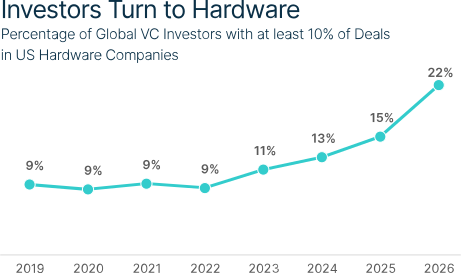 Notes: Numerator is investors with at least 10% of VC deals in US hardware companies; denominator is investors with at least 10% of VC deals in US companies. Source: PitchBook Data, Inc. and SVB analysis.
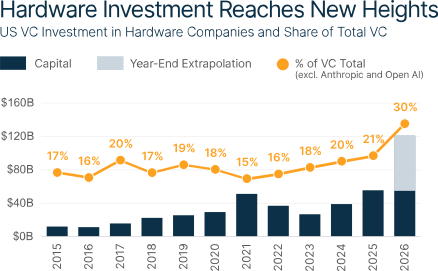 Source: PitchBook Data, Inc. and SVB analysis.
MARKET MOMENTUM
Hardware now commands nearly one-third of VC investment
Excluding the outlier investments in OpenAI and Anthropic, hardware companies account for nearly one-third of all US venture capital invested this year.
Defense tech and aerospace are areas seeing particular enthusiasm. Defense-oriented companies command a 31% valuation premium relative to the broader hardware space.
OPERATOR SURVEY
AI adoption remains limited across warehouse operations
While AI adoption increases with facility size, fewer than half of warehouses larger than 250,000 square feet use AI in day-to-day operations.
Most operators are starting with low-friction use cases such as reporting, labor planning and quality monitoring before expanding into more complex physical AI deployments.
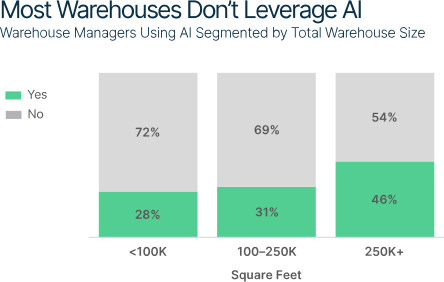 Source: Prologis 2026 survey of 400 warehouse operators and SVB analysis.
Read the full Physical AI and the Future of Robotics report
Get insights into the technologies, investment trends and supply chain shifts shaping the next era of automation.
More about the authors
Explore other First Citizens Innovation Banking Reports
 Reports
 Report
The Future of Climate Tech
Apr 15, 2026
Jordan Kanis, Eli Oftedal, Josh Pherigo, Andrew Pardo
 Reports
Report
Reports
Report
50 BY 2050
Jordan Kanis, Joshua Posamentier, Eliza Cushman, Marianne Wu, Hilla Watkins
 Reports
Report
Reports
Report
The State of Corporate Venture Capital 2026
Mark Gallagher, Patrick Eggen, Mikey Kalis, Emma Eschweiler, Abbie Wolf, Anjalika Komatireddy, Eli Oftedal, Jake Ledbetter